

The Druze-majority Sweida governorate, long relatively insulated from earlier phases of Syria’s 14‑year conflict, has now become a flashpoint.
Briefing an emergency meeting of the Security Council, UN Assistant Secretary‑General Khaled Khiari painted a grim picture: hundreds of casualties among soldiers and civilians –including women, children and the elderly – alongside reports of mass displacement, attacks on infrastructure, and hospitals “at or near capacity” amid power and water cuts.
“There were further alarming reports of civilians, religious figures and detainees being subjected to extrajudicial executions and humiliating and degrading treatment,” he said.
Violent reprisals and looting have devastated communities, with graphic footage circulating widely on social media amplifying fear and anger.
He urged all parties to protect civilians and civilian infrastructure.
Timeline of escalation
12 July: Series of mutual kidnappings in Sweida escalate into armed clashes between Bedouin tribes and Druze armed groups.
14 July: Syrian security forces deploy to “halt clashes” and “restore order”. At least 10 personnel reportedly killed by Druze armed groups, others abducted. Reports surface of the abuses against civilians as forces enter Sweida.
Clashes intensify, leaving hundreds dead or wounded among security forces and Druze fighters, casualties also reported among Druze and Bedouin civilians, including women, children and the elderly. Sectarian rhetoric surges on social media.
15-16 July: Hundreds of Druze from the occupied Syrian Golan and Syria gather on both sides of the ceasefire line, in the presence of the Israel Defense Forces (IDF), expressing solidarity with the Druze community in Sweida.
Israeli airstrikes compound crisis
Against this backdrop, Israel, “pledging to protect” the Druze community launched “escalatory” strikes on Syrian territory, Mr. Khiari said.
Between 12 and 16 July, air raids targeted Damascus authorities’ forces and official buildings, military installations and the vicinity of the Presidential Palace.
“In addition to violating Syria’s sovereignty and territorial integrity, Israel’s actions undermine efforts to build a new Syria at peace with itself and the region, and further destabilise Syria at a sensitive time,” Mr. Khiari said.
He urged both Israel and Syria to uphold the 1974 Disengagement of Forces Agreement and “refrain from any action that would further undermine it and the stability on the Golan.”
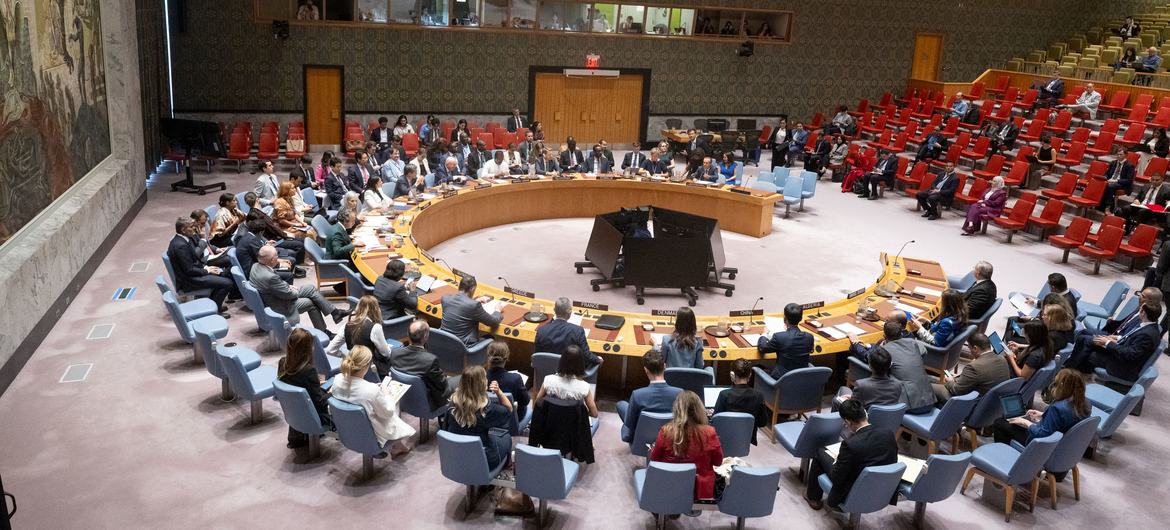
A wide view of the UN Security Council meeting on the situation in Syria.
Humanitarian fallout
According to the UN Office for the Coordination of Humanitarian Affairs (OCHA) there are severe disruption to supply routes, with insecurity and road closures blocking aid deliveries. The UN World Health Organization (WHO) dispatched trauma care supplies to Daraa, but Sweida remains inaccessible.
Mr. Khiari stressed the need for humanitarian access and called on Damascus to ensure any investigations into alleged abuses are “transparent and in line with international standards.”
Call for genuine reconciliation
Reaffirming the Security Council’s March call for an inclusive, Syrian-owned political process under resolution 2254, Mr. Khiari warned: “Security and stability in Sweida, and indeed in post-Assad Syria can only be achieved through genuine reconciliation and with the participation of all components of Syria’s diverse society.”
He urged all Syrian stakeholders to commit to dialogue and emphasised the UN’s support for an inclusive and credible political transition that ensures accountability, fosters national healing and lays the foundation for Syria’s long-term recovery and prosperity.
“Only then, can Syria truly emerge from the legacy of conflict and embrace a peaceful future,” he concluded.