
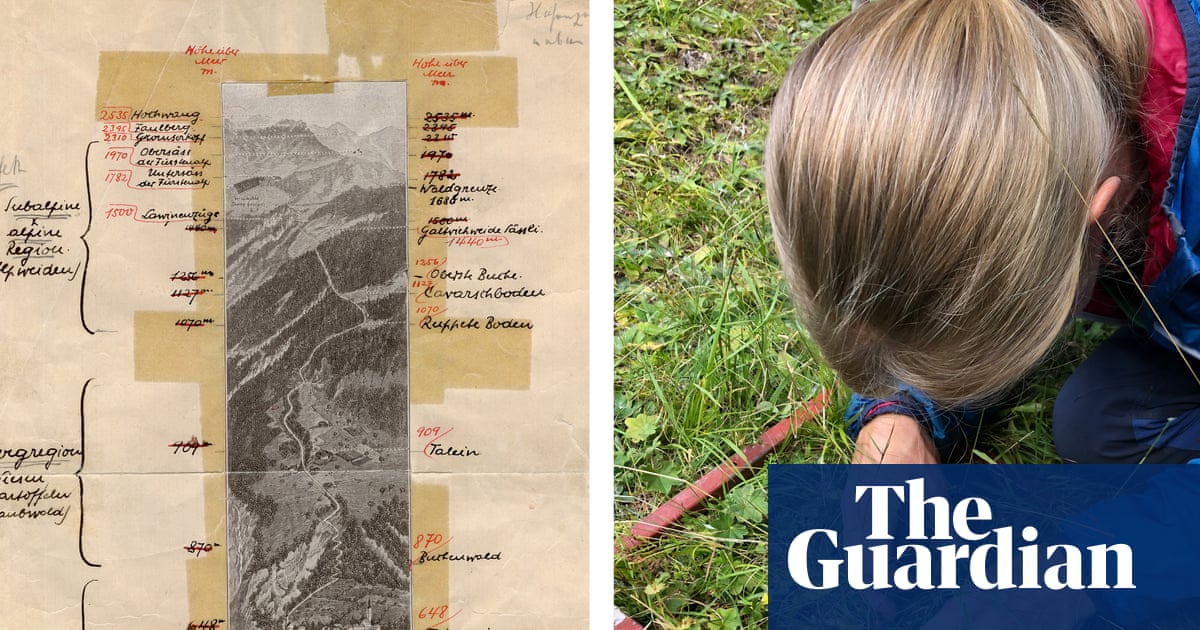
For two years, a team of Swiss researchers crossed the country by train, car and foot, carrying with them a red frame measuring 30 by 30 centimetres. At 277 sites they placed the frame in the grass and counted all of the plant species within it.
The scientists were retracing a path set more than 100 years earlier, when two botanists had done the same thing in exactly the same meadows, long before such plant inventories became common.
By revisiting these places, the researchers hoped to open a window on the grassland that existed before the agrarian revolution that took place from the 1950s to the 80s, when farming was transformed by the mass adoption of fertiliser and agricultural machinery.
“The loss of biodiversity since then was massive,” says Prof Jürgen Dengler, a biologist at the Zurich University of Applied Sciences (ZHAW) and the leader of the project. Their research, published in Global Change Biology, found that across Switzerland, the average number of plant species on agricultural grassland has fallen by 26% over the last century.
On the Swiss plateau – the lowlands where most people live and the most intensive farming takes place – the decline reached almost 40%. Alpine farmland at an altitude of 2,000 metres, protected by steep slopes, remoteness and less-intensive farming, had lost only 11%.
It is a unique window on the past that was almost closed for good. Biodiversity loss is notoriously difficult to quantify. Even in Switzerland, a country with intense monitoring of nature, systematic measurements have only existed for about two decades.
It is not known which plants would have been found on meadows before industrialised agriculture. For most of the world, inventories only began when major losses had already occurred.
The plant inventories from 1884 to 1931 were discovered in preparation for renovations at Agroscope, Switzerland’s agricultural research institute, and were almost thrown away. “Fortunately, a colleague there realised that they do not belong in the wastepaper basket, but that this is a treasure for research,” says Dengler.
The handwritten lists had been put together by two Swiss botanists, Friedrich Stebler and Carl Schröter, who were investigating the productivity of different meadow types.
Surprisingly, almost all of the old meadows they sampled in the 19th and early 20th centuries are still meadows today. Only about 20 plots were excluded because they have since been developed, or are now regenerated forests or a lake.
“We have limited our analyses to what was then and still is agricultural grassland, not on land that has since become a golf course”, says Stefan Widmer, a PhD student who led the field research.
Switzerland is an ideal place for such a study. It is a densely built-up country, but agriculture can be found everywhere. Subsidies keep farming alive even in places such as the Alps, where it has often not survived in other European countries.
But the use of machinery and fertilisers is much more limited at higher altitudes. This allows their impact on species diversity to be studied and compared with other factors such as climate change, the researchers say.
“Our numbers show that land use was the main driver for diversity loss, far more than climate change at this stage,” Widmer says.
The way farmers cut, graze and fertilise their fields shapes which plants survive. More nitrogen fertiliser, more frequent mowing and highly productive plants displacing native species all reduce plant diversity, the analysis shows. A list of all found plant species saw 117 losers and just six winners.
“It was fascinating to see how stark the differences between meadows could be even on the same altitude,” Widmer says about his experience in the field. “Much is also dependent on different farmers cultivating their grassland differently, from those farming very intensively to those who are interested in ecology, who know the species and try to support diversity.”
Since the early 2000s, Swiss meadows have seen a slight increase in plant diversity. “These recent developments did not come out of nowhere,” says Dengler. “They are the result of major agricultural interventions.” Farmers are rewarded for mowing late, extensive rather than intensive grazing, and the presence of target species. This leads to lower yields but is compensated by generous subsidies.
And there is some reassurance about nature’s resilience, as an additional part of the research project shows: when they could not find the old species in their 30 by 30cm plots, the scientists increased their search radius by 500 metres. There they rediscovered all of the old species, often in areas that were either protected or used for biodiversity promotion – an indication that political measures to preserve nature are working.