

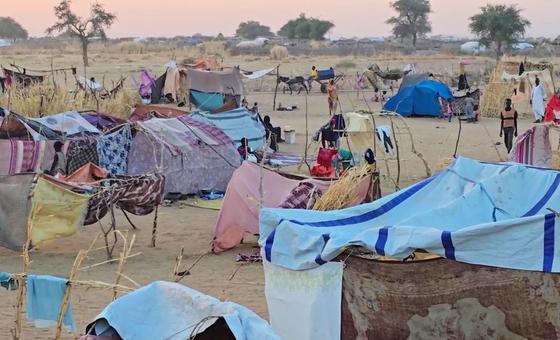
“We can only expect worse to come” unless action is taken to halt the bloodshed, Mr. Türk told Member States at the Human Rights Council in Geneva, as he reiterated his call for the extension of an arms embargo from Darfur to include all of Sudan.
Rival militaries from the national army and Rapid Support Forces (RSF) militia have been battling for control of the country for nearly three years.
Something must be done to address the “continuous inflow of weapons”, the High Commissioner for Human Rights insisted, after recounting testimonies of survivors of atrocity crimes in El Fasher, the capital of North Darfur, by paramilitary Rapid Support Forces (RSF) who overran the city last October.
Mass killings
“In one horrific example, people who fled to separate locations, thousands of kilometres apart, gave consistent accounts of the mass killing of hundreds of people sheltering at El Fasher University,” he said, describing convincing testimony that some victims were targeted based on their non-Arab ethnicity – in particular, members of the Zaghawa ethnic group.
“Survivors also spoke of seeing piles of dead bodies along roads leading away from El Fasher, in an apocalyptic scene that one person likened to the Day of Judgment,” the High Commissioner continued, his comments echoing the International Criminal Court’s (ICC) conclusion last month that war crimes and crimes against humanity had taken place in El-Fasher, linked to the RSF’s siege.
“Our own findings are fully consistent” with that ICC assessment, Mr. Türk told the Human Rights Council, at a meeting held specifically on the Sudan emergency.
Dire warnings
Previously, the UN rights chief noted that his office has warned about previous atrocity crimes such as the RSF offensive to capture Zamzam camp for displaced people in April 2025.
“Responsibility for these atrocity crimes lies squarely with the RSF and their allies and supporters,” he said.
The war in Sudan erupted in April 2023, after a power-sharing agreement broke down in the resource-rich central African nation between the Sudanese Armed Forces (SAF) and the RSF.
The resulting humanitarian emergency has affected more than 30 million people in Sudan; many have faced repeated displacement and others have been impacted by famine and systematic sexual violence, including gang rape.
As the fighting continues away from the Darfurs in the west to the central Kordofans regions, observers fear that further grave abuses are bound to happen, including by “advanced drone weaponry systems used by both sides”, Mr. Türk warned.
Deadly drone war
“In the last two weeks, the SAF and allied Joint Forces broke the sieges on Kadugli and Dilling,” the High Commissioner said. “But drone strikes by both sides continue, resulting in dozens of civilian deaths and injuries.
Civilians are at risk of summary executions, sexual violence, arbitrary detention, and family separation.”
Mediation measures
In a bid to prevent further bloodshed, the High Commissioner announced a series of measures “to support mediation efforts” and de-escalate violence.
These include commitments not to target civilians or residential areas with explosive weapons, to enable the unimpeded delivery of humanitarian aid, to end arbitrary detention and cease attacks on civilian infrastructure.
“I witnessed the damage done by RSF attacks on Merowe dam and hydroelectric power station, which once supplied 70 per cent of Sudan’s electricity. Repeated drone strikes have disrupted power and water supplies to huge numbers of people, with a serious impact on healthcare,” he said.