

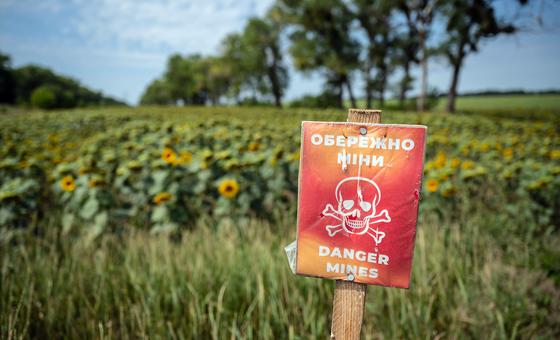
At least 58 States and territories remain contaminated with these weapons, which are designed to detonate when a person comes into contact with them.
Some have even been around since the two World Wars along with other unexploded ordnance, and millions more remain in national stockpiles.
“It is deeply troubling that almost 30 years since the Anti-Personnel Mine Ban Treaty was adopted, these explosive weapons continue to kill and injure people, often decades after they were placed,” said Volker Türk, the UN High Commissioner for Human Rights.
He stressed the need for States to “recommit to putting an end to the production, use and transfer of these weapons and redouble their efforts to cooperate in clearing mines already placed”.
Thousands killed and injured
Anti-personnel mines affect the full range of human rights, including civil, political, economic, social and cultural, the report said, and they are still being used today, including by non-State actors.
At least 1,945 people were killed and 4,325 injured by landmines and explosive remnants of war in 2024, the latest numbers reveal.
The highest rates of casualties were in Myanmar, Syria, Afghanistan, Ukraine, Nigeria, Mali, Yemen and Burkina Faso.
Civilians account for roughly 90 per cent of all recorded casualties, and children have made up over 40 per cent of all civilian casualties recorded since 1999.
Amputations, blindness and no-go zones
The report details how anti-personnel mines inflict harm and impact the enjoyment of human rights.
Civilians have had limbs amputated, suffered eye injuries, including blindness, or sustained hearing loss because they stepped on or handled these weapons.
Moreover, children experience more severe physical trauma and higher fatality rates from anti-personnel mine injuries than adults, with the probability of survival decreasing the younger they are.
Mine contamination also turns areas into no-go zones, which can prevent civilians from accessing essential services, block humanitarian assistance to those in need and drive displacement. It can also contribute to food insecurity and economic hardship by making farmland unsafe to use.
Meanwhile, mines planted in and around schools have endangered children and hindered their education.
Contamination of explosive remnants of war, including anti-personnel mines, also can hamper economic development for decades and delay post-conflict reconstruction.
Appeal to States
Currently, 162 States are party to the Anti-Personnel Mine Ban Convention, also known as the Ottawa Convention, which opened for signature in the Canadian capital in December 1997.
OHCHR noted that numerous States, including permanent members of the UN Security Council and others whose armed forces have used or maintain considerable stockpiles, are not yet parties.
Furthermore, five States – Estonia, Finland, Latvia, Lithuania and Poland – have recently withdrawn from the treaty, while Ukraine, a State party, has indicated suspension of its implementation of the convention.
“States that have not yet ratified the treaty should promptly do so, and those that have withdrawn should quickly rejoin. States that are parties to it should adhere to its provisions in good faith,” Mr. Türk said.
He commended Lebanon’s recent decision to join the treaty, even when faced with grave security threats.
The High Commissioner also called on States to provide reparations for violations that result from the use of anti-personnel mines and to ensure that survivors and affected communities have access to healthcare, rehabilitation, education, employment and social security.
The report will be presented to the UN Human Rights Council in Geneva on 26 June.