
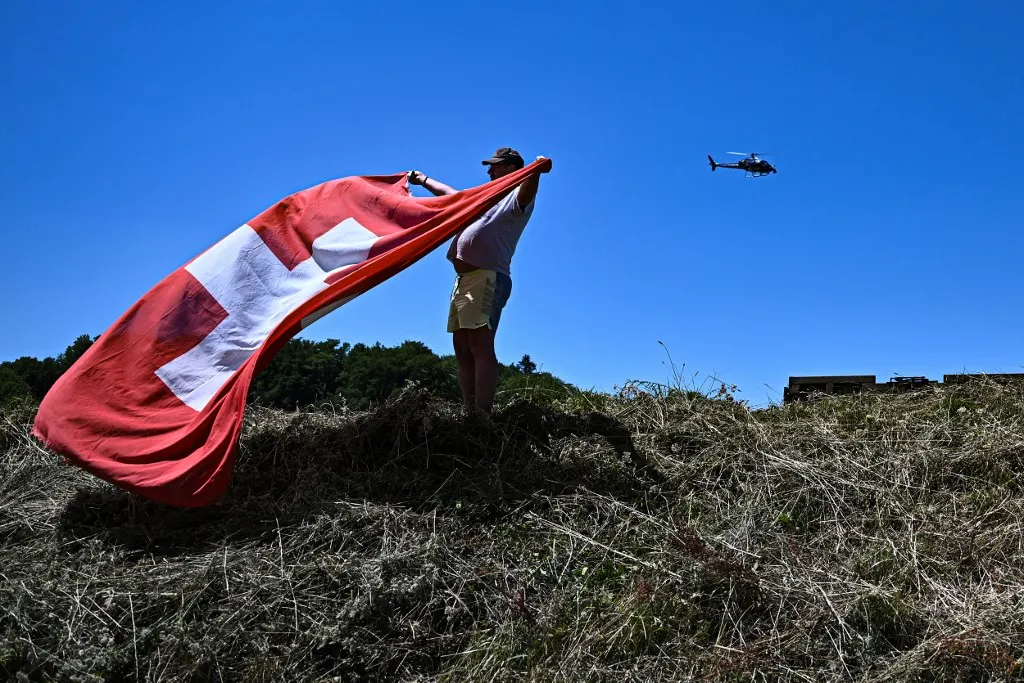
Swiss voters will decide on September 27th whether to keep their neutrality as it currently is, or if it should be more restrictive. But how different is it really from other European countries’ policies of non-intervention in world affairs?
Whether or not voters approve the bid to toughen the principles of neutrality – such as banning the government from imposing most economic sanctions, for instance – neutrality will remain as ‘Swiss’ as cheese, chocolate, and yodelling.
In fact, in most people’s minds, the word ‘neutrality’ is synonymous with Switzerland.
However, several other countries are neutral as well – including Switzerland’s closest neighbours – Liechtenstein and Austria.
But a look at other nations shows that neutrality is not the same everywhere.
Don’t miss our journalists’ daily news roundup from Switzerland
Let’s start with Austria
In many ways, this country’s stance most closely resembles Switzerland’s.
It is the only other European state to hold a status of permanent neutrality recognised under international law. And, like Switzerland, it maintains an army tasked with defending its territory and its neutrality.
The main difference between Swiss and Austrian neutrality lies in the fact that Austria has been a member of the EU since 1995.
Ireland
Unlike Switzerland or Austria, Ireland doesn’t have a status of permanent neutrality formally recognised under international law.
Its neutrality rests primarily on a political tradition and a desire to assert the national sovereignty it gradually secured after gaining independence from the UK.
Another major difference from Switzerland is that Ireland devotes relatively few resources to its defence.
Malta
The neutrality of this group of Mediterranean islands is far more flexible than Switzerland’s, and closely tied its colonial history
After having gained independence from the UK in 1964, it had become neutral to safeguard its newly-born sovereignty.
Though it prohibits membership in military alliances, it is – like Ireland and Austria – a member of the European Union, and in this way differs from Switzerland as well.
Moldova
This Eastern-European country’s brand of neutrality bans any foreign military presence on its territory, but Russia’s invasion of Ukraine has also led Moldova to question its neutral status.
The prospect of closer ties with the European Union and NATO is sparking increasingly heated debate.
The Vatican and San Marino
The two tiny nations enclaved within Italy both claim a form of neutrality but for different reasons.
The Holy See’s neutrality enables the Pope to fulfill his mission of standing above conflicts between states, allowing him to act as a mediator and a moral authority.
As for San Marino, it has long cultivated a tradition of non-interference and non-alignment – mostly due to its small size.
Liechtenstein
Another tiny nation, Liechtenstein has been neutral since 1868, when it disbanded its military and declared itself as sovereign and non-aligned.
It does not have an army …though it does have a 125-person strong police force.
And then there are (formerly neutral) Sweden and Finland, which ended up joining NATO following Russia’s invasion of Ukraine
How are all these countries different – in terms of neutrality – from Switzerland?
First and foremost, it’s fair to say is that Switzerland is the model on which all other ‘neutralities’ are based – more or less loosely.
While the other nations (excelt Liechtenstein) adopted this policy in the 20th century, Switzerland’s dates back to 1815, so it is the world’s oldest and most established.
This means Switzerland has been more consistently neutral than others.
Secondly, unlike Austria, Ireland, and Malta, Switzerland is not a part of the EU and, unlike Moldova, it doesn’t aspire to become a member.
(In that respect, Switzerland is more like the Vatican and San Marino, which have stayed out of such alliances).
Also, like Austria, Ireland, Malta, and Moldova, Switzerland has a standing army – purely for defence purposes – which sets it apart from Liechtenstein, San Marino and the Vatican – though in the latter’s case, the Swiss do guard the Pope!
So it is fair to say therefore that is some ways, Swiss neutrality aligns with other nations’, and in others, it is quite different.
READ MORE: Why is Switzerland always neutral?