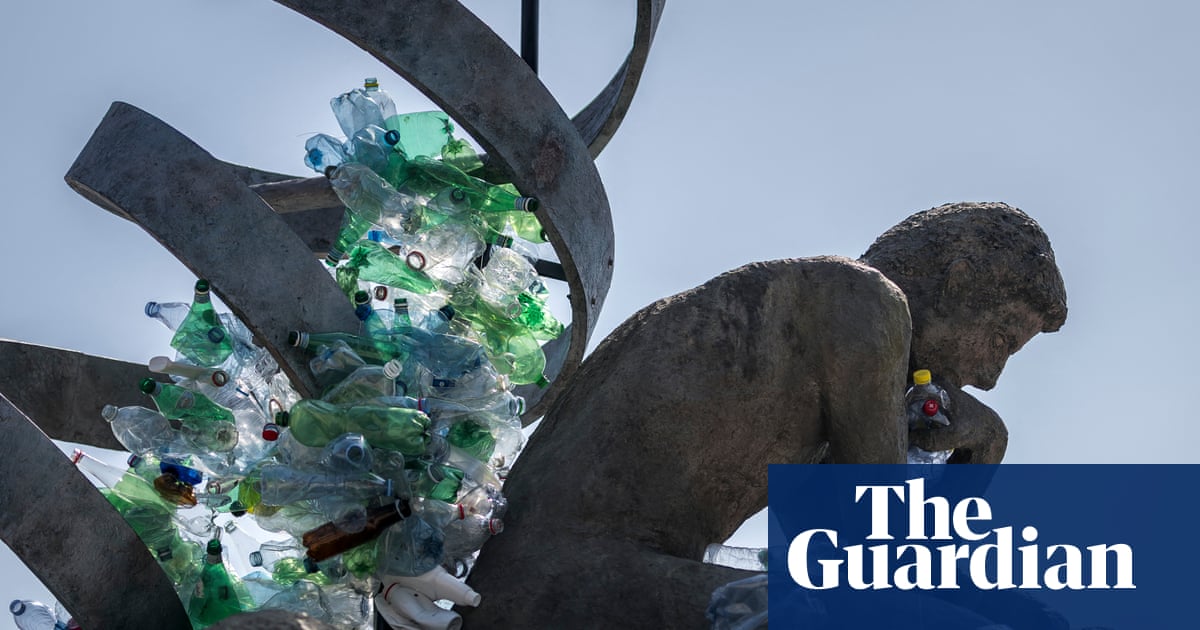
Talks between nations to hammer out a plastics treaty to end plastic pollution continued behind closed doors in Geneva on Thursday, the final day of negotiations, as civil society groups urged countries to “hold the line” to secure a strong agreement.
With time running out to seal a deal between 184 countries, environmental groups expressed concern that frontline communities, Indigenous people and others suffering the worst impacts of the world’s growing plastic crisis were being “sold out” in an effort to secure a treaty, without meaningful or legally binding measures that would address the scale of the problem, “at any cost”.
This week’s negotiations towards a legally binding agreement to tackle plastic pollution are the latest in five rounds of talks over the past two and a half years, which have so far failed to produce a deal.
Talks at the UN offices stalled on Wednesday after a consensus draft treaty, presented by the chair of the event, Luis Vayas Valdivieso, was rejected by 80 countries. The ambitious countries – who want curbs on production – described it as “unacceptable”, a “lowest common denominator” and a toothless waste management instrument, because it did not include production caps nor address the chemicals used in plastic products.
Countries from the “like minded” group, chiefly oil-producing countries and including Saudi Arabia, who want the treaty to focus on recycling and voluntary measures, said it crossed too many of their red lines and did not do enough to pare down the scope of the treaty.
Graham Forbes, Greenpeace’s head of delegation, said: “The entire day has been behind closed doors. All of civil society is on edge, waiting to see what the next move is going to be from the chair and from the secretariat. We are nervous, we are anticipating, and we’re concerned that we’re going to be sold out in an effort to get a treaty at any cost.
“Civil society, frontline communities, Indigenous peoples, everyone is united in wanting to see something meaningful here. And we’re praying that these governments are going to do the right thing and put our collective health before short term profits for the petrochemical sector.”
A rush for a weak treaty in Geneva, Forbes said, “would be a disaster”.
Some NGOs said they had “lost faith” in a process with the need for consensus between a majority of countries that want production caps versus a small but powerful minority of oil- and plastic-producing nations that continue to reject production limits.
Christina Dixon, a campaign lead at the Environmental Investigation Agency, said the need for consensus was being “weaponised”.
“A lot of civil society have lost faith in the process, because we’ve consistently seen a majority of countries aligning around a vision for the type of treaty that we’d be happy with. Yet, because of the way that this is being weaponised, we’re constantly bowing to a small but vocal minority who are holding it hostage,” she said.
This system was allowing a majority of countries to be “drowned out”, Dixon said. She urged: “What we need to see tonight is that the views of that majority reflected fairly.”
after newsletter promotion
Earlier on Thursday, Camila Zepeda, the director general for global affairs at Mexico’s ministry of foreign affairs and a negotiator at the talks, said: “If [the next treaty draft] is exactly the status quo, then we’ll need to assess if it’s better to then keep working and trying to find a better environment for this topic, but it’s too early to tell …
“We understand it will be a very simple treaty at this stage. But if the key components are there and we can build it in time, then we will be signing. By now, we’ve given up bans, we’ve given up production limits. We’ve given up so much, so much.
“As ambitious countries, we want an outcome, and we see that if we don’t get an outcome, we’re risking a lot. But at the same time, we won’t take just anything.”
Before this week’s talks, an expert review published in the Lancet described plastics as “a grave, growing and under-recognised danger to human and planetary health”. It estimated health-related damages globally added up to £1.1tn annually, with infants and children particularly vulnerable.
However, some delegates were still hopeful. Sivendra Michael, the Fiji government’s permanent secretary for the ministry of environment and climate change, said: “There is still time. There are still processes that the chair can explore. There are many other innovative processes that have worked in other multilateral settings that can be explored.
“It’s important for us to take a step back and reflect that we are negotiating at the edge of a planetary emergency.”
The talks continue.
Quick Guide
Contact us about this story
Show

The best public interest journalism relies on first-hand accounts from people in the know.
If you have something to share on this subject you can contact us confidentially using the following methods.
Secure Messaging in the Guardian app
The Guardian app has a tool to send tips about stories. Messages are end to end encrypted and concealed within the routine activity that every Guardian mobile app performs. This prevents an observer from knowing that you are communicating with us at all, let alone what is being said.
If you don’t already have the Guardian app, download it (iOS/Android) and go to the menu. Select ‘Secure Messaging’.
SecureDrop, instant messengers, email, telephone and post
If you can safely use the tor network without being observed or monitored you can send messages and documents to the Guardian via our SecureDrop platform.
Finally, our guide at theguardian.com/tips lists several ways to contact us securely, and discusses the pros and cons of each.