
Marking its 30th anniversary, ISA is the world’s authority on the deep-sea beyond national jurisdiction. Washington may have passed an order on deep-sea licensing in international waters earlier this year, but the authority’s chief Leticia Carvalho said the United States, which is not an ISA member, “is going at it alone”.
“The rest of the world is united and cohesive and all behind of the rule of the law and the International Seabed Authority,” Ms. Carvalho told UN News. “ISA is a super power. We have all the knowledge, we have the ability given by the law, we have the mandate.”
Indeed, under international law, the deep seabed beyond national jurisdiction belongs to no single nation, Ms. Carvalho said, inviting the United States to join ISA.
To address these concerns, ISA has been drafting a mining code as a way to ensure that the deep-sea remains protected and does not turn into the “Wild West” of exploitation, she said.
Read our explainer on ISA and why it matters now here.
Costly search for rare minerals
Rare minerals needed to satiate demands for producing tech items from batteries to solar panels have driven interest in the deep-sea and what it offers. From cobalt to zinc, a plethora of rare earth minerals have been observed by explorations of the ocean floor.
ISA has issued 31 contracts for mineral exploration to 21 firms from 20 countries as of 2024, according to the UN’s World Economic Situation and Report 2025. While commercial mining in international waters has not yet commenced, pending the finalisation of an international code for deep-sea mining by the ISA, right now, countries can pursue deep-sea mining within their own territorial waters or “exclusive economic zones”.
Even after the international code is in place, those engaged in deep-sea mining will continue to face major challenges due to high capital requirements and operational costs relative to conventional mining and the enormous technical uncertainties associated with the unique problems surrounding mining on the ocean floor, according to the UN report.
‘One of our last frontiers’
UN Secretary-General António Guterres said the international seabed is “the common heritage of humankind, a principle enshrined in the UN Convention on the Law of the Sea, which must continue to guide us”.
“We must bring together our global efforts in climate action, biodiversity preservation and marine protection,” he said in a message marking ISA’s anniversary, commending its commitment to finding balanced and effective solutions. “The deep ocean remains one of our last frontiers. It holds great promise, but also requires great caution.”
For 30 years, the authority has helped protect this shared realm through peaceful, sustainable and inclusive governance, and today, it is navigating complex challenges with care and clarity, he said, emphasising that “as we mark this milestone, let us advance cooperation grounded in science, and keep working together to safeguard the ocean for the benefit of all people, everywhere.”
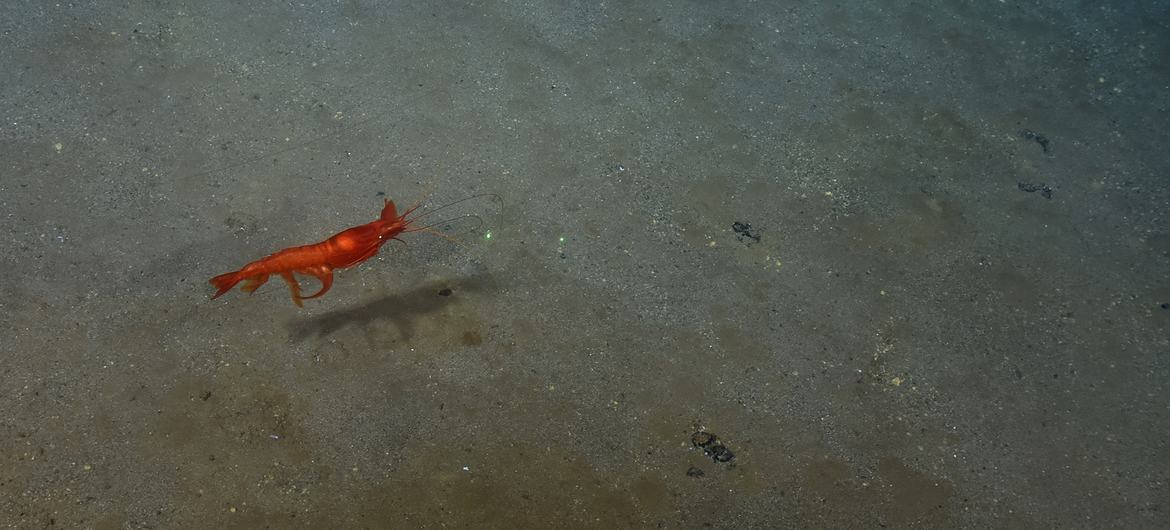
The deep-sea contains a plethora of life and rare earth minerals.
Mining code and more
In addition to achieving progress on a draft mining code at its ongoing annual session at headquarters in Kingston, Jamaica, ISA launched its Deep-Sea Biobank last month in a bid to preserve and share knowledge.
The initiative aims to collect and preserve samples from the ocean floor that will benefit all nations, especially developing countries, Ms. Carvalho said, adding that the goal is to study the minerals, exploration and exploitation potential, but also to preserve and to study biodiversity and genetics.
“The future that I see is we need to really take care, cherish [and] nurture the deep-sea,” Ms. Carvalho said. “The future of ISA is stronger, enhanced, wider and wiser. We will know much more than we know now.”