
Briefing the Security Council on Thursday, Khaled Khiari, Assistant Secretary-General for the Middle East, said the OIC remains an “indispensable” partner in efforts to promote peace, uphold international law and deliver durable political solutions in a range of crisis contexts.
Headquartered in Jeddah, Saudi Arabia, the OIC has 57 member States and five observers, representing significant political, economic cultural and religious constituency.
“Its voice carries considerable weight in some of the world’s conflict-affected situations,” Mr. Khiari said.
“The UN values this partnership, not only as a matter of institutional cooperation, but as an essential component of our efforts to promote durable peace, inclusive governance and respect for international and human rights law.”
He emphasised that the cooperation aligns with Chapter VIII of the UN Charter, which encourages partnerships with regional organizations in maintaining peace and security, and with the Pact for the Future, adopted by Member States last September to revitalise multilateralism and tackle global challenges through collective action.
Helping resolve crises
Mr. Khiari outlined joint UN-OIC work in Gaza, including the recent endorsement by the bloc and the League of Arab States of a recovery and reconstruction plan as well as collaboration on the question of Jerusalem through an annual conference held in Dakar, Senegal.
In Sudan, where over two years of war have brought devastating humanitarian consequences, he welcomed the OIC’s backing for international mediation, including support for the UN Secretary-General’s Personal Envoy, Ramtane Lamamra.
Turning to Afghanistan, Mr. Khiari praised the OIC’s role in the UN-led “Doha Process”, noting its continued engagement with the Taliban de facto authorities and advocacy for the rights of Afghan women and girls, an area where the OIC’s moral and religious standing carries particular influence.
On Myanmar, the OIC remains an essential voice in global efforts to ensure a safe, dignified and voluntary return of the Rohingya to Rakhine state. He noted sustained coordination between the UN Secretary-General’s Special Envoy and the OIC in pushing for accountability and citizenship rights.
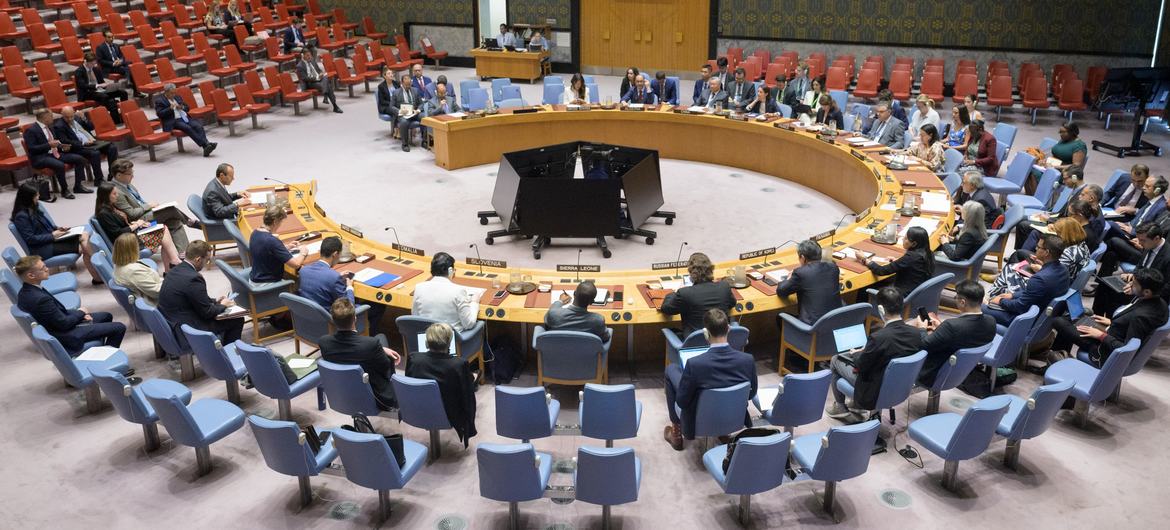
A wideview of the Security Council as ASG Khaled Khiari briefs members about cooperation between the UN and the Organisation of Islamic Cooperation.
Cooperation on global issues
Assistant Secretary-General Khiari also highlighted the growing collaboration between the two organizations on elections, including training on observation and women’s political participation. A new staff exchange programme is also helping to strengthen institutional ties.
He acknowledged the OIC’s leadership in countering Islamophobia and all forms of religious intolerance, an area where the UN has stepped up efforts, including through the appointment of a Special Envoy.
Counter-terrorism cooperation has also advanced following a March 2024 memorandum of understanding. Joint initiatives include technical support, parliamentary engagement and rights-based prevention strategies.
“As we move forward with the implementation of the Pact for the Future,” Mr. Khiari concluded, “the UN-OIC partnership will remain critical to defusing tensions, advancing sustainable peace and reinforcing multilateral norms and principles.”