

Hungarian opposition leader Peter Magyar has scored a landmark election victory over Prime Minister Viktor Orban, ousting US President Donald Trump’s closest ally in Europe on promises of rebuilding the country’s European Union ties while curbing them with Moscow.
“The election results are not final yet, but the situation is understandable and clear,” Orban said late on April 12 as results showing Magyar’s center-right Tisza party with a sizeable lead over Orban’s right-wing Fidesz.
“The election result is painful for us, but clear. The responsibility and possibility of governing was not given to us. I have congratulated the winner.”
With nearly all ballots counted, Tisza led with 53.6 percent of the vote, compared with 37.8 percent for Fidesz, according to the Hungarian election committee.
Preliminary calculations give Tisza 138 seats in the 199-member parliament — enough, if confirmed, to give it the two-thirds majority needed to push through constitutional changes.
“My fellow Hungarians — we have done it!” Magyar told supporters in Budapest. He said his first trip abroad will be to Warsaw, where he has received strong backing from Polish Prime Minister Donald Tusk.
“Back together! Glorious victory, dear friends!” Tusk wrote on X, adding in Hungarian: “Russians, go home!”
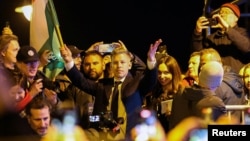
Magyar said he would then “go to Vienna and Brussels to have EU funding released.”
The outcome of the elections was closely watched in Brussels, Kyiv, Moscow, and Washington.
Trump did not answer questions shouted by reporters about Orban as he walked away following his return to Washington on April 12.
Pushback Against Authoritarian Trends
Veteran American diplomat Daniel Fried described Hungary’s stunning election result as “a very big deal,” saying it signals a broader pushback against authoritarian trends in Europe and beyond.
Speaking to RFE/RL on April 12, Fried — who has served in senior national-security roles under seven US administrations and is now a distinguished fellow at the Atlantic Council — said he was surprised by both the speed and scale of the outcome.
“I am a bit surprised that we know the results this quickly,” he said, noting that many observers had expected a prolonged count.
“So the fact that Viktor Orban has conceded shows that this is the kind of landslide victory that [the opposition] wanted and that Hungarian pro-democracy people prayed for, but that no one expected until it came.”
Hungary’s troubled relationship with many countries in the EU means the bloc’s 27 members were keenly interested in the outcome of the vote, as were Washington and Moscow, both of whom have strong ties with Orban, who has held power for the past 16 years.
“Hungary has chosen Europe. Europe has always chosen Hungary. A country reclaims its European path,” EU Commission President Ursula von der Leyen said soon after Orban conceded.’
Ukrainian President Volodymyr Zelenskyy congratulated Magyar on his “convincing victory” and wrote on Telegram: “It is important when the constructive approach wins.”
As an EU member, Orban’s government has managed to block or water down many of the bloc’s decisions on sanctions against Russia following its full-scale invasion of Ukraine in 2022. It has also prevented some EU support for Ukraine.
Recently, he stopped a 90 billion euro ($105 billion) loan for Kyiv for 2026 and 2027, initially agreed by EU leaders in December 2025.
Last month, Hungarian police seized two vans carrying more than $80 million in cash and 9 kilograms of gold bars, along with seven Ukrainian citizens, who were en route from Austria to their home country in what was considered the regular transportation of monetary instruments.
These steps came after Orban accused Ukraine of stopping deliveries of Russian oil via the Druzhba pipeline. Ukraine says the pipeline was damaged by Russian strikes and repairs would take time.
Leaked Calls To Russia
All of these issues fed into the election campaign, as have leaked telephone calls in which Hungarian Foreign Minister Peter Szijjarto appeared to be briefing his Russian counterpart, Sergei Lavrov, on high-level EU meetings.
After first denying it, Hungary’s foreign minister then confirmed that he not only speaks to Russian colleagues before and after EU meetings, but also to counterparts from Israel, Serbia, Turkey, and the United States.
“France salutes a victory of democratic participation, of the Hungarian people’s attachment to the values of the European Union, and for Hungary in Europe,” French President Emmanuel Macron said after calling to congratulate Magyar on his victory.
“Together, let us advance a more sovereign Europe, for the security of our continent, our competitiveness, and our democracy.”
Meanwhile, Magyar’s primary focus in the election campaign was on domestic issues, particularly an anti-corruption campaign.
In an interview with RFE/RL in October 2025, he indicated that his foreign policy instincts would be cautious.
In particular, he said that there would be no quick end to Russian fossil fuel imports, despite EU pressure for Hungary — and neighboring Slovakia — to fall into line with steps taken by other member states to fully cut energy ties with Moscow by 2027.
Hungary currently imports around 95 percent of its natural gas supplies from Russia, while during the first half of 2025 some 92 percent of its oil imports came from Russia.