
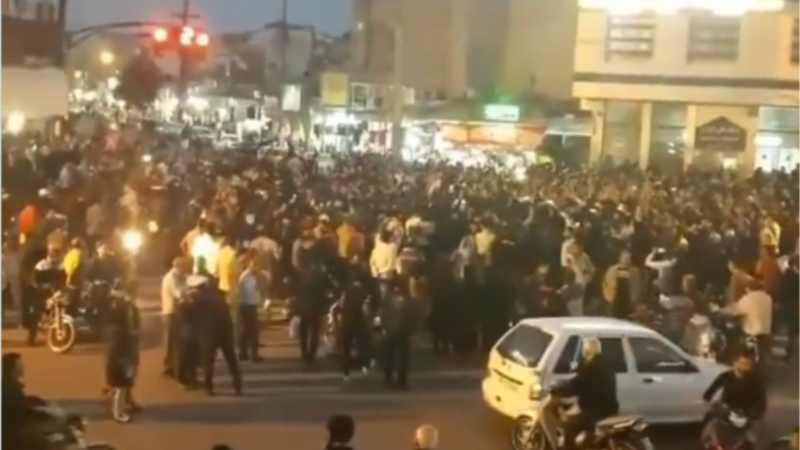
Iranian authorities braced for more unrest in multiple regions on January 2, with the death toll and arrests mounting after protesters angered by the country’s economic woes hit the streets for the fifth day in a row.
State-controlled media and international rights groups on January 1 reported at least seven deaths and dozens of injuries in clashes between demonstrators and security forces, although government-linked news agencies blamed what it called “rioters.”
Iranian authorities have yet to confirm the reports and RFE/RL’s Radio Farda could not independently verify them.
Iranian President Masud Pezeshkian — considered a relative moderate by many observers — sought to ease tensions, saying he recognized Iranians’ “legitimate demands” while urging the government to take action to ease economic hardships.
“From an Islamic perspective… if we do not resolve the issue of people’s livelihoods, we will end up in hell,” Pezeshkian said on state television.
Hard-line security forces, however, vowed to take a “firm” stance against protesters and those who “exploit” the situation to cause chaos.
Saeid Golkar, an associate professor at the University of Tennessee who follows Iran, wrote on social media that the new wave of protests is “driven by economic grievances but fundamentally rooted in the regime’s repression, ideological policies, and incompetence.”
Ali Fathollah-Nejad, founder and director of the Berlin-based Center for Middle East and Global Order, wrote on December 30 that “the Islamic republic finds itself at a crossroads. Renewed nationwide protests are the result of accumulated crises: rapid currency depreciation, water and electricity shortages, rising fuel prices, inflation bordering on hyperinflation, ecological destruction, etc.”
Reports Of Protest Deaths
The Fars news agency, which is close to the Islamic Revolutionary Guards Corps (IRGC), reported protests in the city of Lordegan in the southwest, saying clashes with security forces had occurred. It cited “an informed source” as saying that “two people had lost their lives.
Norway-based human rights group Hengaw also reported deaths in Lordegan, saying security forces had opened fired on protesters, killing two and wounding several. The group also said a protester was killed in Isfahan Province in central Iran on December 31.
“Protests took place in several areas of Lordegan, including Municipality Square and in front of the government building. Demonstrations were met with violent repression, including the use of tear gas and live ammunition by law enforcement forces,” the group said.
Fars later reported that three people were killed and 17 injured around 8 p.m. in clashes between security forces and demonstrators in Azna, a city of 48,000 people in western Iran’s Lorestan Province. The unconfirmed report stated that protesters had attacked a police station.
The IRGC, meanwhile, said on January 1 that a member of its Basij volunteer paramilitary unit was killed a day earlier in the western city of Kuhdasht, also in Lorestan Province.
Arrests Mount In Multiple Areas
The Tasnim news agency said at least 30 people had been arrested in the capital, Tehran, for ‘disturbing public order.” Arrests were also reported in other areas, including in Malard and in the provinces of Alborz, Lorestan, and Chaharmahal and Bakhtiari.
In Malard, just west of Tehran, Fars quoted the deputy governor as saying, “Investigations show that a number of those arrested had arrived in Malard from neighboring towns, which are now in the hands of security agencies.”
“A number of other elements related to these actions have been identified, and operations to arrest them are on the agenda,” it added.
Social media videos and reports said markets in Tehran were again closed on January 1, with merchants marching in the streets as they battle an inflation spiral sparked by a free-fall of the currency.
Serious Challenge
The unrest appeared to be the most serious challenge to Iran’s theocratic government since the “Women, Life, Freedom” protests erupted following the September 2022 death of 22-year-old Iranian-Kurdish student Mahsa Amini while in police custody over a dress-code violation.
Pezeshkian earlier called on citizens to show solidarity instead of joining protests. He also promised that the government would make “new decisions” that would improve the economic situation.
This did little to temper the anger of Iranians, who have been besieged by inflation of more than 50 percent and a slumping rial currency that is trading on unofficial markets at around 1.4 million to the dollar, compared with around 800,000 one year ago.
Official exchange rates are better but unavailable to many Iranian individuals and businesses.
“The recent protests reveal one clear reality: Many Iranians have decided that the current establishment must end — at any cost and as soon as possible — before the country they love is further destroyed,” Shirin Ebadi, who was awarded the 2003 Nobel Peace Prize for her efforts to bring democracy and safeguard human rights in Iran, told Radio Farda in a phone interview on January 1.