

Wrapping up a visit to the country, Edem Wosornu, who heads operations and advocacy for the UN humanitarian affairs coordination office (OCHA) said that she could “feel the momentum for change” on the ground after years of suffering and hardship under the Assad regime ended with its overthrow last December.
But formidable challenges remain as 16.5 million Syrians require humanitarian assistance and protection, and needs are “staggering”.
Speaking from Gaziantep, a humanitarian hub in Türkiye just across the Syrian border, Ms. Wosornu noted an “encouraging trend of returns” since last December.
Over one million internally displaced people have come back to their areas of origin, she said, and more than half a million refugees have returned from neighbouring countries according to the UN refugee agency (UNHCR).
Devastated homes and opportunities
The OCHA official cited insecurity, damaged homes, inadequate services, lack of livelihood opportunities and the threat of unexploded ordnance as “key barriers” preventing people returning.
“People say, first and foremost they want security,” she stressed.
While the level of hostilities in the country has subsided, Ms. Wosornu said, localized tensions and clashes remain a “major concern”.
Remnants of heavy fighting pose a continued threat to civilians, said Dr Altaf Musani, the UN World Health Organization (WHO)’s Director of Health Emergencies.
He pointed to at least 909 casualties from unexploded ordnance since December 2024, including some 400 deaths – a majority of them women and children.
“We’re starting to see the admission rates and consultation rates in emergency rooms increase… Children and women, going about their daily life, trying to get water, trying to get food, trying to rebuild,” are walking through agricultural land, roads and rivers where unexploded munitions could be hiding, he said.
Camp residents at highest risk
Diseases, such as cholera and acute watery diarrhoea, are spreading, Dr. Musani said, stressing that more than 1,444 suspect cases of cholera and seven associated deaths have been recorded.
“This is particularly in Latakia and Aleppo, particularly around displacement camps,” he said.
“We know that when cholera gets hold in camps, it can serve as a brush fire, increasing both morbidity and mortality.”
The WHO official warned that more than 416,000 children in Syria are at risk from severe malnutrition and that more than half of children under five suffering from severe acute malnutrition are not receiving treatment.
“From a public health standpoint, we need to be able to watch that risk and intervene and save those children,” he said.
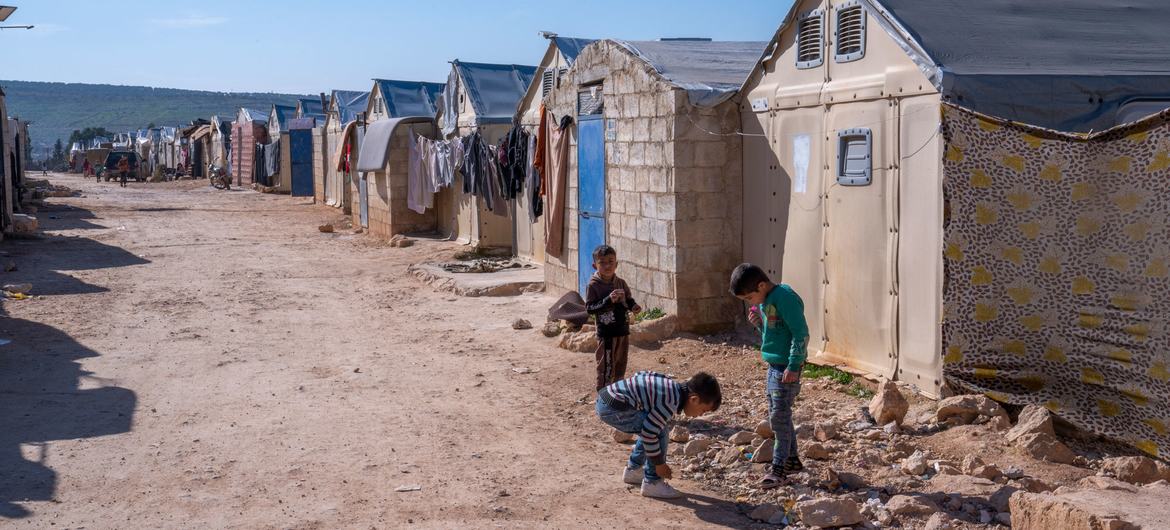
Boys play in an informal camp in Syria.
Pregnancy dangers
Dr. Musani also noted that half of the maternity hospitals in northwest Syria have suspended operations since September 2024 owing to financial cuts, which humanitarians are “witnessing globally” but which are “really apparent” in Syria.
Underfunding of the humanitarian operation in Syria is already severe. Earlier this week, OCHA’s Coordination Division head, Ramesh Rajasingham, told the Security Council that out of the $2 billion required for the UN and its partners to reach eight million of the most vulnerable people from January through June 2025, only 10 per cent has been received.
The country’s cash-strapped health facilities face a lack of skilled workers and equipment, said WHO’s Dr. Musani. The war had pushed some 50 to 70 per cent of the health workforce to leave the country in search of other opportunities, and the health infrastructure is in dire need of investment.
The WHO official noted that for the health system – the “heartbeat of the nation” – the sanctions imposed on the country during the Assad regime had resulted in a lack of much-needed upgrades, compromising the purchase of new MRI machines, CT scanners, laboratory equipment and software upgrades.
Over the past two weeks, both the United States and the European Union have moved to lift the sanctions. OCHA’s Ms. Wosornu expressed hope that thanks to this development “we’ll see the impact on goods and services, on the cost of doing operations in the country, on the ability to move goods quicker into the country”.
But “it will take time”, she added. “I believe the people of Syria are hopeful that this will change their everyday lives.”