

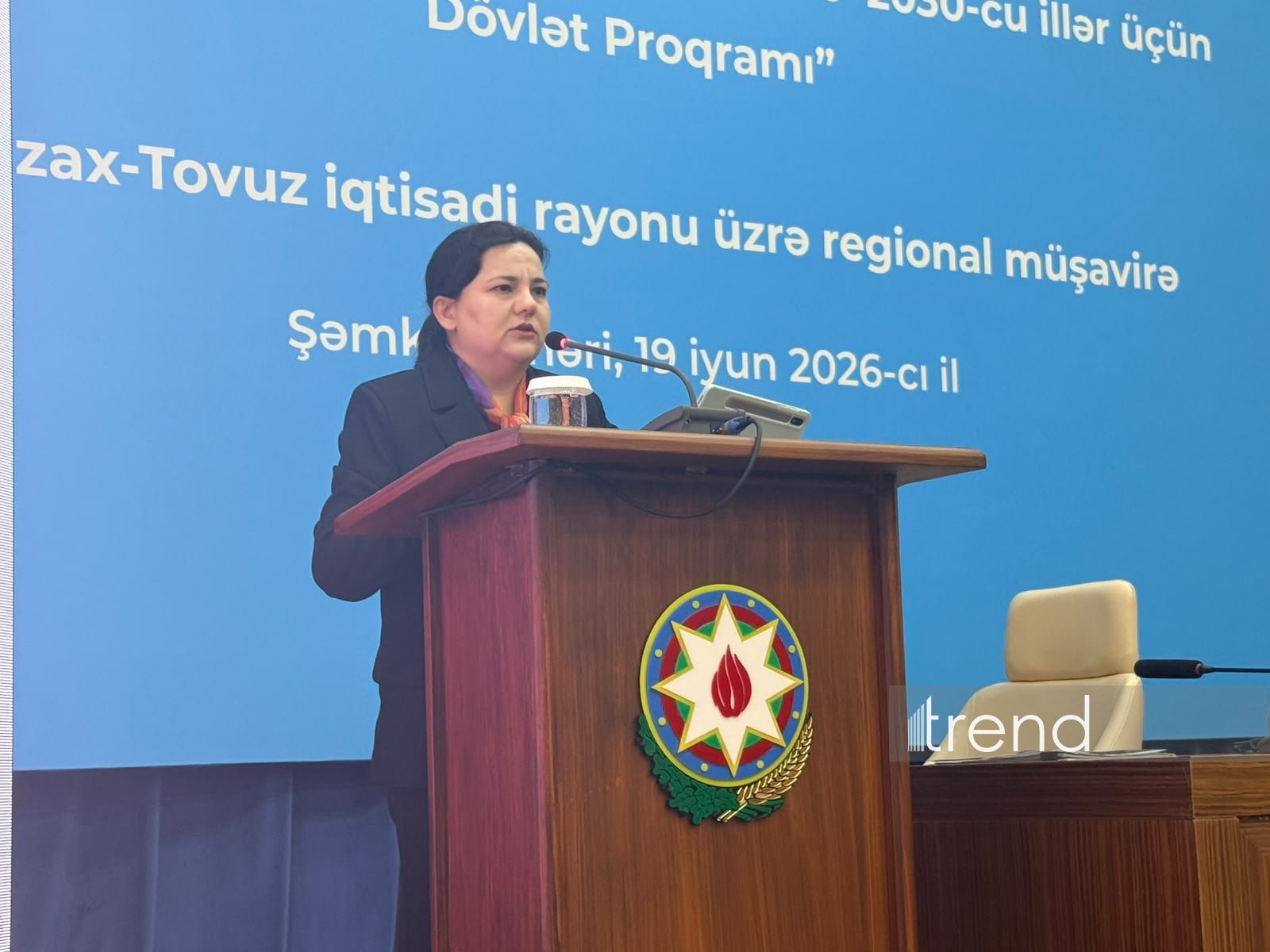
SHAMKIR, Azerbaijan, June 19. The State Program
for the Development of Agricultural Production and Processing,
Fisheries, and Aquaculture in Azerbaijan for 2026–2030 has
especially identified several fundamental directions, Deputy
Minister of Agriculture Ilhama Gadimova said, Trend‘s correspondent
reports from the event.
She made the remark at a regional consultation on the
Gazakh-Tovuz economic region, held in Shamkir to discuss the state
program approved by the decree of the President of Azerbaijan dated
May 25, 2026.
According to the deputy minister, the main directions include
increasing intensive garden areas, increasing wheat productivity,
expanding modern irrigation areas, expanding agropark and
greenhouse activities, forming small wineries, and increasing
intensive livestock farms.
“Besides, the program covers not only production areas, but also
supporting measures. Legislative initiatives, institutional
reforms, and digitalization are important pillars of this program.
It is planned to improve the legislation ‘On the agricultural
sector’, ‘On seed production’, ‘On fisheries’, make changes to the
subsidy rules and mechanisms for applying discounts to agricultural
machinery.
Concurrently, the expansion of the agricultural artificial
intelligence system and the development of data-oriented subsystems
of the Electronic Agricultural Information System (EAIS) will serve
for more flexible and information-based management of the
field.
Today, agrarian policy is no longer limited to the work done in
the field. Our decisions should be based on data, maps, electronic
systems, satellite observations, soil and water balance, and real
productivity indicators. Therefore, digitalization is becoming an
important tool for both farmers and the state,” she explained.
Gadimova pointed out that one of the most important directions
of the program is to increase wheat production and increase
productivity.
“As many as 22 districts have been identified as target regions
for wheat production. These regions provide a large part of the
grain produced in the country and have higher irrigated areas,
modern irrigation potential, agropark infrastructure, and laser
leveling capabilities. Shamkir and Tovuz districts are included in
the list of these 22 districts.
It’s planned to bring the average yield to 50 centners in the
target regions, and to 30 centners in the Damya regions, which also
include Aghstafa and Gadabay. In the perspective districts,
including the Gazakh district, the yield target is set at 50
centners after 2029,” she noted.
The deputy minister said that in order to achieve the targets,
it is planned to expand the application of modern irrigation
systems, improve technical support, apply laser leveling
technology, increase state support for wheat production, and
strengthen control over agrotechnical maintenance.
“First, the application of modern irrigation systems will be
expanded. Second, technical support will be improved. Third, the
application of laser leveling technology will be expanded. Fourth,
state support for the development of wheat production will be
increased. Fifth, control over agrotechnical maintenance will be
strengthened, and necessary land reclamation measures will be
implemented. One of the support mechanisms that should be specially
noted here is the subsidization of loan interest rates.
It’s planned to pay the part of the annual interest rate of
loans provided by banks to farmers for the production of annual
crops, not exceeding 19 percent, from the state budget. This is an
important support in terms of reducing the financial burden of
farmers and attracting funds more easily for the crop cycle,” she
clarified.
She noted that another important support is related to laser
leveling.
“For every ton of the product produced by farmers applying laser
leveling, it is envisaged to apply an additional product subsidy to
both the farmer and the mill for each ton delivered to the mills.
This mechanism both encourages the farmer to use the technology and
strengthens the relationship between processing enterprises and the
producer,” Gadimova pointed out.
The deputy minister said that subsidies alone aren’t enough to
increase productivity in wheat production. Seeds should be selected
correctly, soil analysis should be conducted, sowing should be
carried out in the optimal period, the fertilization rate should be
determined in accordance with the real composition of the soil,
irrigation should be carried out on time, and the fight against
diseases and pests should not be delayed.
According to her, the next main direction is the expansion of
modern irrigation systems.
“The efficient use of water resources is one of the most urgent
issues in agriculture today. Climate change, reduced precipitation,
and increased demand for water necessitate the transition to more
economical and more efficient irrigation technologies,” she
said.
Gadimova highlighted that the state program has identified the
expansion of the application of modern irrigation, increasing the
beneficial use of water, and increasing productivity as the main
goals. In this direction, the application of pivot, drip, and
sprinkler irrigation systems will be expanded.
She said that currently, the areas where modern irrigation
systems are installed are 130,000 hectares.
“It is projected that this indicator will reach 300,000 hectares
by 2030, of which 88,100 hectares are planned in 22 target
districts, and 12,000 hectares in 8 perspective districts,” added
the official.