

On April 15, Armenian Prime Minister Nikol Pashinian announced that TRIPP — the Trump Route for International Peace and Prosperity — had entered its implementation phase.
Framed as a potential breakthrough after decades of conflict between Armenia and Azerbaijan, the project would link Azerbaijan to its Nakhchivan exclave via Armenian territory, while positioning the route as part of the broader Middle Corridor connecting Asia to Europe.
But the timing may prove challenging.
The ongoing US–Israel with Iran war risks undercutting Washington’s ability to follow through on the ground.
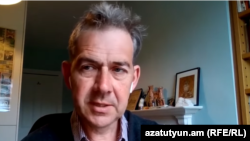
Thomas de Waal of Carnegie Europe told RFE/RL that deploying US personnel near the Iranian border — for studies, security, or oversight — will be difficult as long as the conflict continues, raising early questions about how quickly the project can move beyond announcements.
RFE/RL: Given the current geopolitical climate, what could realistically slow or derail TRIPP’s implementation in the near term?
Thomas De Waal: I think there was good energy behind TRIPP in the first phase, with the Americans pushing it. Then there was the important agreement in Washington in January, followed by JD Vance’s visit to the region, strengthening bilateral relations with both countries. So now we’re down to the implementation phase, and I think the major obstacles have largely been removed.
The ambition is to get the railway finished, or mostly completed, before the end of Trump’s second term in 2028. There is clearly a political ambition to do that.
Unfortunately, I think the war in Iran is already complicating things for two reasons. First, it will be difficult to have Americans on the ground near the Iranian border — doing studies or overseeing the work. That’s simply too dangerous as long as there is a conflict with Iran.
Second, they want private money to contribute to TRIPP. There is an initial American contribution of about $400 million, but to get more done, they need private investment. It will be harder to attract investors to a project that is literally just across the river from Iran.
So I think a lot depends on how the conflict with Iran goes and the longer it goes on, the more the other people who have competing ideas, the Russians, obviously, we’ve seen the beginnings of some kind of reconciliation between Baku and Moscow in the last week, which I think is not a coincidence, and obviously Georgia is still the default transit route. And maybe it’s also not a coincidence that [Azerbaijani President Ilham] Aliyev recently visited Georgia.
RFE/RL: Iran has opposed TRIPP from the start. In practical terms, what can Tehran actually do to obstruct the project – and has the ongoing war changed its leverage or willingness to act?
If TRIPP happens, Russia will want to use it and cooperate with the Americans. [..] If there are problems, Russia can say: ” You can rely on us, we have better relations with Iran. So Russia is exploring all options.
De Waal: We saw the impact that just a few rockets near Nakhchivan airport had on the region. You only need one or two missiles to create an impression of danger, and that already causes problems.
There are many scenarios in Iran — continuing conflict with the United States, or continuing a hardline regime, or instability, even internal unrest. All of those scenarios, I think, will make people more worried about TRIPP.
RFE/RL: How about Russia? Where does Russia stand on TRIPP right now?
De Waal: Russia is looking at each moment and trying to get the best out of it. If TRIPP happens, Russia will want to use it and cooperate with the Americans. I’m sure they’ve been discussing that.
If there are problems, Russia can say: ” You can rely on us, we have better relations with Iran. So Russia is exploring all options.
RFE/RL: There are reports that US attention is shifting away from TRIPP as it is busy with Iran. Do you think the US commitment to the project is weakening?
De Waal: No, I don’t see that. This agreement is very important to the Trump administration — and personally to Donald Trump. It carries his name, so it carries prestige. There is a strong American incentive to make it work.
RFE/RL: What about funding? Is there a risk that TRIPP becomes underfunded?
De Waal: The railway across southern Armenia — from Syunik to Nakhchivan — is just 42 kilometers. I think the money can be found for that, from different actors: regional players like Azerbaijan and Turkey, the Gulf states, the US, the EU, and international banks.
Where it’s more problematic is other projects outside TRIPP. For example, the Kars-Dilucu railway could cost around $2.5 billion, and that may rise because of the mountainous terrain and tunnels required. So there are question marks there — but for the TRIPP railway itself, I’m quite confident funding can be found.
RFE/RL: Armenia is due to hold parliamentary elections on June 7, with Nikol Pashinian seeking reelection after years of tension with Moscow and domestic criticism over Nagorno-Karabakh. Is the West doing enough to counter reported Russian influence ahead of Armenia’s elections?
De Waal: I think the West is doing enough. Much of the work is happening behind the scenes — including security support from France and the United States, physically protecting Pashinian from possible danger.
I don’t see Russian efforts in Armenia as very successful. To be effective, they need a strong opposition to work with, and that doesn’t really exist.
There’s also an interesting question for Azerbaijan: whether it prefers a strong Armenian leadership. Some say yes, others worry that a stronger Pashinian would be more independent and closer to the West and create a problem for us.
But overall, I would be surprised if Pashinian does not win a solid victory.