


Maintained for use in an emergency: a civil defence shelter in Switzerland.
Afp Or Licensors
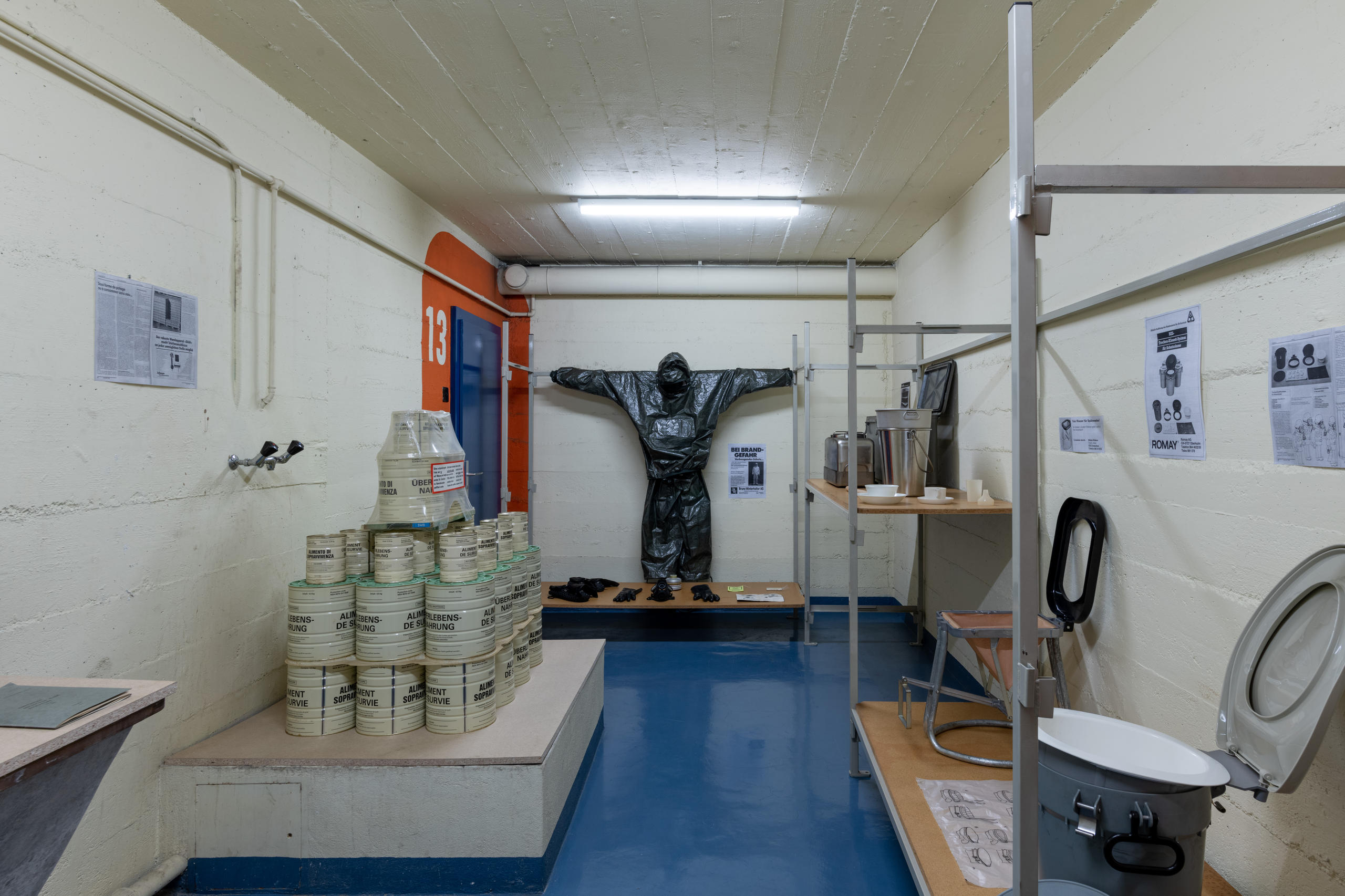
A heavy armoured door leading to an underground room with shower, dry toilet, cooker and bunk beds: welcome to a fallout shelter. Switzerland has around 370,000 fallout shelters – around 5,000 of them public – housing over nine million people.
But in the face of ageing infrastructures and technological developments in weaponry, these shelters are less and less suited to today’s threats. This is why, “in view of the changing global security situation”, the Swiss federal government decided last October to investExternal link massively in public shelters over 40 years old.
An obligation dating back to the Cold War
How is it that a country like Switzerland, known for its neutrality, has so many fallout shelters? Let’s take a quick look back. At the height of the Cold War, with the East and West facing each other over the nuclear threat, Switzerland promulgated a federal law requiring the construction of protected places for every inhabitant of the country.
More specifically, the Federal Law of October 4,1963 on civil protection constructions requires the construction of a shelter to be included in every new dwelling. If this is not done, you have to pay a tax – ranging from CHF400 to CHF800 (€437 to €874) per person – to finance the construction of a space in a public shelter.
Swiss-style bunkers are also appreciated abroad:
More
More
Switzerland sets ‘gold standard’ for designing bunkers
For these public shelters, many underground structures in Switzerland (car parks, motorway tunnels, etc.) will be designed as bunkers that simply need to be closed with large sliding armoured doors to make them completely airtight. These systems can accommodate thousands of people.
Whether private or public, the law requires that these shelters can be reached quickly on foot: within 30 minutes maximum in the valley and 60 minutes in the mountain regions for each inhabitant. The cantons or communes are required to plan and regularly update the distribution of the population in the shelters. This allocation planning is communicated when the security policy situation so requires.
Another component of civil protection involves secure hospitals and underground health posts integrated with health care facilities. These facilities must cover at least 0.6% of the population. They are co-financed by the Confederation and the cantons, but here too the equipment is ageing and many sites are currently inactive or being used for training purposes.

A shelter beneath a care home in Switzerland.
Afp Or Licensors
A system called into question
Since the end of the Cold War, the concept has come under increasing public pressure. In 2010, Switzerland considered ending this obligation. It finally modified it slightly in 2012. It is no longer necessary to include a shelter in new buildings in regions that already have enough of them. In fact, there are major disparities between regions, for example, canton Bern (107%) has better coverage per inhabitant than Geneva (76%)External link. The obligation also only applies to the construction of “large buildings”, although the cantons remain responsible for exceptional regulations.
However, the amount of tax paid by private individuals who do not wish to build a shelter is still being questioned, especially as the Swiss federal government recently decidedExternal link to increase this tax to CHF1,400 (€1,530 euros) per space not built by homeowners in areas where there is a shortage.
More

More
Subscribe to our weekly top stories
“In peacetime, spending on war scenarios is not very popular. However, it must always be assumed that the security policy situation could one day deteriorate and that an armed conflict in Switzerland cannot be ruled out”, explains the Federal Office for Civil Protection (FOCP) in its brochureExternal link for the general public.
According to the Swiss media, the cantonal coffers currently contain around CHF880 million (€962 million)External link funded by this replacement tax. It is precisely this money that the authorities want to use to renovate public shelters that are more than 40 years old.
Bunkers transformed into party rooms
Most of the existing fallout shelters are not immediately operational. Many have been reinvested as storage space or underground car parksExternal link, while others serve as wine cellars or party rooms for their owners.
“People do just about anything and everything,” Christian Sinigaglia, director of a company specialising in the construction and renovation of fallout shelters, told RTBF, citing the recent example of a pottery kiln discovered in a shelter.
The FOCP, for its part, points out that owners must ensure that shelters are equipped and maintained so that they are functional in the event of armed conflict. In peacetime, however, they may use the premises for other purposes “provided that no changes are made to the shelter envelope (floor, walls and slabs), armoured doors and shutters and ventilation system”.

More
Neutrality
Construction and renovation standards remain very strict and are normally checked at least every ten years to ensure that they can be used quickly if necessary.
“As these shelters are intended for use in the event of armed conflict, their use requires a decision by the Swiss federal government, which would be relayed by the Federal Office for Civil Protection to ask us to prepare the shelters, i.e. empty them, prepare them, assemble the beds, etc. We have five days to do this once the order is given”, explains Louis-Henri Delarageaz, commander of the Vaud civil protection, to Swiss public broadcaster, RTS, the Swiss Radio and Television station, which itself has an underground studio accessible from its car park, to ensure continuity of information in the event of a crisis.
Limited autonomy and space
As well as being impervious to nuclear radiation and chemical attack, fallout shelters must be able to withstand the collapse of buildings above them and missile strikes.
They are generally designed for a maximum oxygen autonomy of 14 days, using a ventilation and filtration system. This period has been calculated on the basis of the decline in radioactivity in the air after an atomic explosion. In the event of an alert, however, living conditions would be complicated, as the law stipulates that each person must have at least one square metre of space. There would also have to be sufficient food and water.
In short, to be prepared for any eventuality despite the low risks. That’s what Switzerland is all about.
This article has originally been published by RTBFExternal link on February 23, 2006. Translated from French to English by the EBU/amva.