

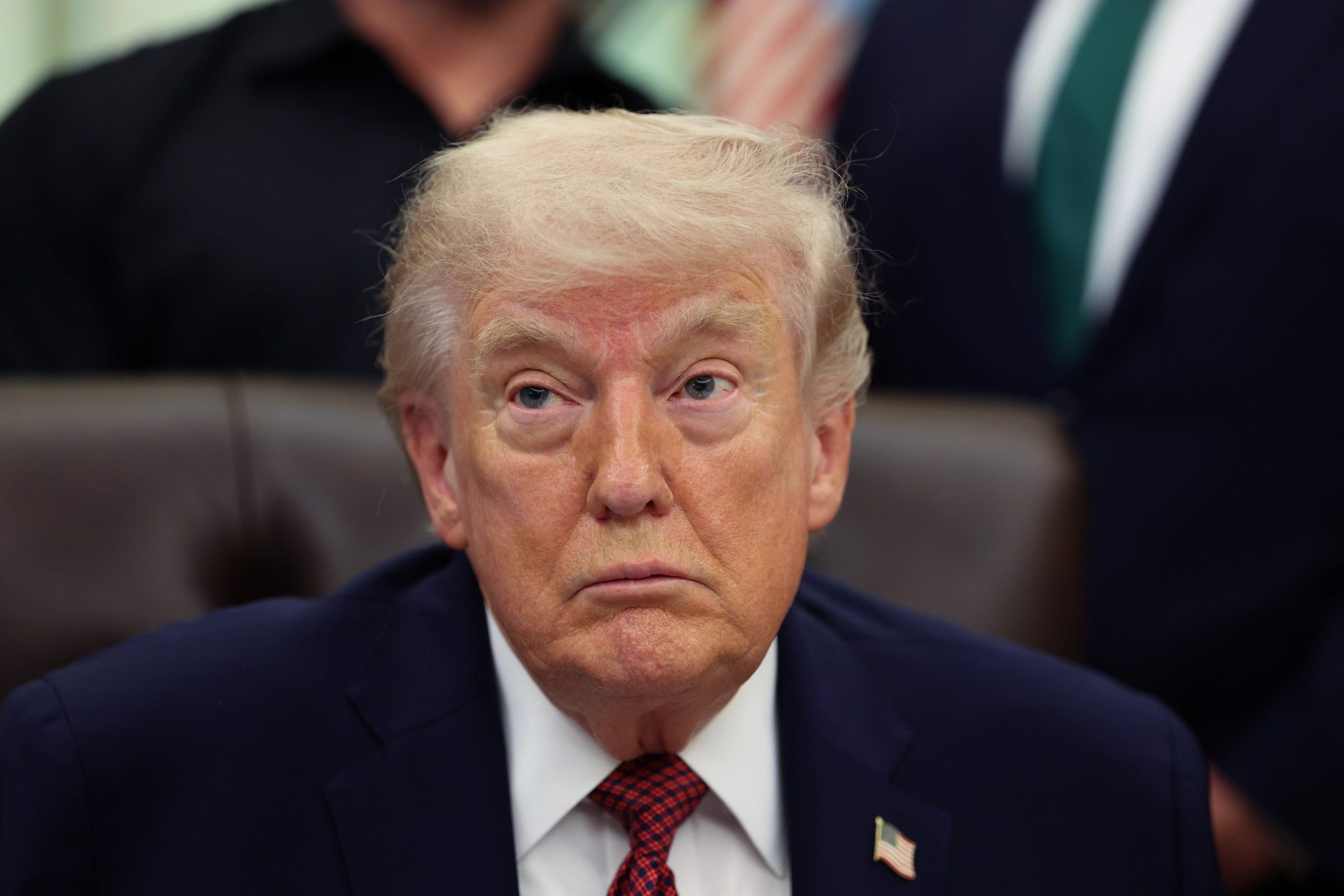
When President Donald Trump returned to office last year, he framed his tariff policy as a bid to bring manufacturing of strategic materials and equipment back to U.S.
More than a year later, his sweeping trade agenda has indeed forced a crackdown on imports, so much so that a single technological force has grown into the primary engine of the country’s trade economy.
The AI boom has been the undisputed hotspot of the U.S. economy during the past year. While the technology itself has yet to translate into significant productivity or employment gains, investment in the infrastructure and computing power that has enabled AI’s rollout has been massive. AI-related private investment in the U.S. last year hit $286 billion, according to Stanford University’s AI index report, around the same as the lifetime cost of the entire Apollo program in today’s dollars.
Infrastructure and research costs accounted for more than $140 billion of that sum, with a large chunk earmarked to build the massive data centers that have been powering the AI boom. That splurge has required enormous amounts of raw construction materials, not all of which can be cheaply sourced in the U.S. The AI boom, in fact, is one of the only factors keeping U.S. import growth in positive territory.
A league of its own
AI-related products accounted for 23% of all U.S. imports last year, according to a study published earlier this month by the Federal Reserve Bank of Minneapolis. Those products include the technical stuff—storage hardware, graphic processing units, and the like. But data centers are buildings first and foremost, and the construction frenzy has led to surging demand for cooling, heating, and ventilation equipment.
Taken together, imports of AI-related products have grown 73% since 2023, while imports of non-AI-related products have risen only 3% over the same period, the study found. The findings suggest that despite the Trump administration’s tariff pressure—designed in part to bring the AI supply chain to U.S. shores—domestic manufacturing still isn’t enough to satisfy the data center buildout’s needs.
“Trade in AI-related products is a very important force behind U.S. trade over the past year,” Michael Waugh, the author and an economist at the Federal Reserve, wrote in the study.
“In fact, it might be even more important than dramatic changes in U.S. trade policy.”
Waugh’s findings point to the AI buildout becoming so dominant it’s offsetting weakness almost everywhere else in the import market. With AI-related products stripped out, non-AI imports in January 2026 were actually 14% below their typical 2023 level.
The largest trading partners for AI products last year were Taiwan and Mexico, which together account for around half of the AI-related trade. Taiwan remains a crucial hardware supplier, particularly when it comes to semiconductor chips, the building blocks underlying the massive computing power required to train and run AI models. Mexico sells computing equipment to the U.S. too, but it’s also a critical provider of electrical wiring and HVAC systems needed to build data centers.
An unmissable trade
The outsized role of AI in the country’s import economy becomes even starker when placed within the context of the trade deficit. If AI imports and exports had grown at the same pace as the non-AI trade since 2023, the U.S. goods trade deficit in 2025 would have been about $194 billion smaller, or nearly 16% lower, than the actual $1.2 trillion gap, a record high.
Waugh’s accounting attributes $265 billion in AI imports last year, compared with $71 billion in AI-related exports, underscoring the AI manufacturing supply chain remains a net drag on the trade balance despite the sweeping scale involved. A year after Trump’s tariffs kicked in, the country’s reliance on imports for AI continues to dog the president’s long-stated goal of shrinking the trade deficit.
The global nature of the AI supply chain isn’t lost on the administration, the study suggests. Waugh found effective tariff rates on AI-related products were only 4.5% at the end of 2025, versus 12.1% for non-AI goods, largely because product-level exemptions carved out much of the AI supply chain from the broader tariff wall. Around 69% of AI-related imports fell on at least one exemption list, according to the study.
Beefing up domestic manufacturing capacity of AI-related products was always going to be a tall order for the administration. Semiconductor facilities, for one, require massive upfront capital costs and specialized labor to operate, and attempts to expand in the U.S. have run into regulatory hurdles.
Intel has seen a planned facility experience multiple delays, while Taiwanese company TSMC, the world’s largest semiconductor manufacturer, has encountered labor and compliance problems in setting up a chip factory in Arizona. U.S. manufacturing overall has struggled over the past year, with factory employment down since Trump returned to office, in part because of the administration’s immigration crackdown.
The Trump administration is likely well aware of these challenges. Even when the president had a chance to reorganize his trade policy earlier this year (when the administration moved to reinstate some tariffs after the bulk of them were struck down by the Supreme Court) the sweeping exemptions for AI-related products largely remained in place, Waugh found in his study.