
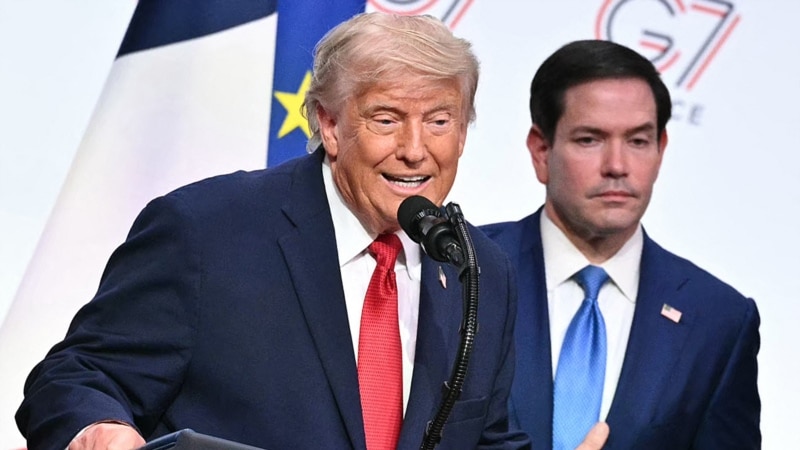
WASHINGTON — Senior US officials have disclosed details of the framework deal with Iran that is set to be officially signed during a ceremony in Switzerland on June 19.
The memorandum of understanding envisages ending the fighting on all fronts, including in Lebanon, reopening the Strait of Hormuz to commercial traffic, and ending the US naval blockade on Iran, according to the text read out on a background call with reporters on June 17.
Upon officially signing the deal, the two sides commit to agreeing to a final settlement in 60 days that includes limits to Iran’s nuclear program and the removal of US sanctions on the Islamic republic, the US officials said.
“This is fundamentally an agreement that allows us to open the Strait of Hormuz immediately, commits the Iranians to destroying the nuclear stockpile, and then gives us a dial,” one senior US official said.
The accord, which has already been signed electronically, marks the most sweeping US-Iran diplomatic breakthrough in years and comes after months of war, maritime disruption, and back-channel negotiations involving regional mediators.
Despite presenting the agreement as a major diplomatic opening, US officials repeatedly stressed deep skepticism about Tehran’s intentions and warned military and economic pressure could quickly resume.
A second senior US official said a critical test would come at talks in Switzerland this weekend, where negotiators are expected to try to convert the memorandum into a sequencing plan for implementation.
“The meeting this weekend in Switzerland will be quite critical,” the official said. “If one party is not meeting the expectation of the other party, we’ll hopefully know within days or weeks, not months.”
Hormuz Toll-Free, US Blockade Lifted
One of the most significant provisions requires Iran to facilitate safe commercial shipping through the Strait of Hormuz free of charge for 60 days, while negotiating a longer-term maritime framework with Oman and Arab states in the Persian Gulf.
The United States will begin ending its naval blockade immediately upon the official signing and fully remove it within 30 days, according to the text.
Officials said the provision was already having an impact. “For the first time in the 100 days of this conflict, Iran did not fire at any vessels,” one official said.
The accord also provides for waivers allowing Iranian oil exports to resume, a move officials defended as economically pragmatic despite criticism from some conservative US politicians.
Iran’s Nuclear Stockpile
The nuclear provisions appear to be the most politically sensitive and strategically significant.
Iran reaffirms it “shall not procure or develop nuclear weapons,” while agreeing that its enriched uranium stockpile would at a minimum be down blended on-site, the US officials said.
“That’s the floor,” one official said. “We will push for more than that.”
A senior US official said Washington would rely heavily on the UN nuclear watchdog and US technical teams for verification. “We’re not in the trusting business,” the official said.
The official added that US personnel were prepared to assist in physically removing nuclear material, if required.
Officials also said damage from recent US air strikes on Iranian nuclear facilities had significantly limited Tehran’s ability to quickly recover the material.
Sanctions Relief Tied To Compliance
The deal envisions the eventual lifting of all US primary and secondary sanctions on Iran, but only as part of a final agreement.
The United States would also release billions in frozen Iranian assets in stages, contingent on what officials described as “good behavior.”
“What Iran wanted was access to these funds upon signing,” one official said. “What they conceded is that they wouldn’t get any money unless they performed.”
The agreement also outlines a reconstruction and development fund worth at least $300 billion, backed by Washington and regional partners, although officials emphasized Washington would not directly contribute funds.
Instead, sanctions waivers would allow Gulf investors and others to finance projects in Iran.