
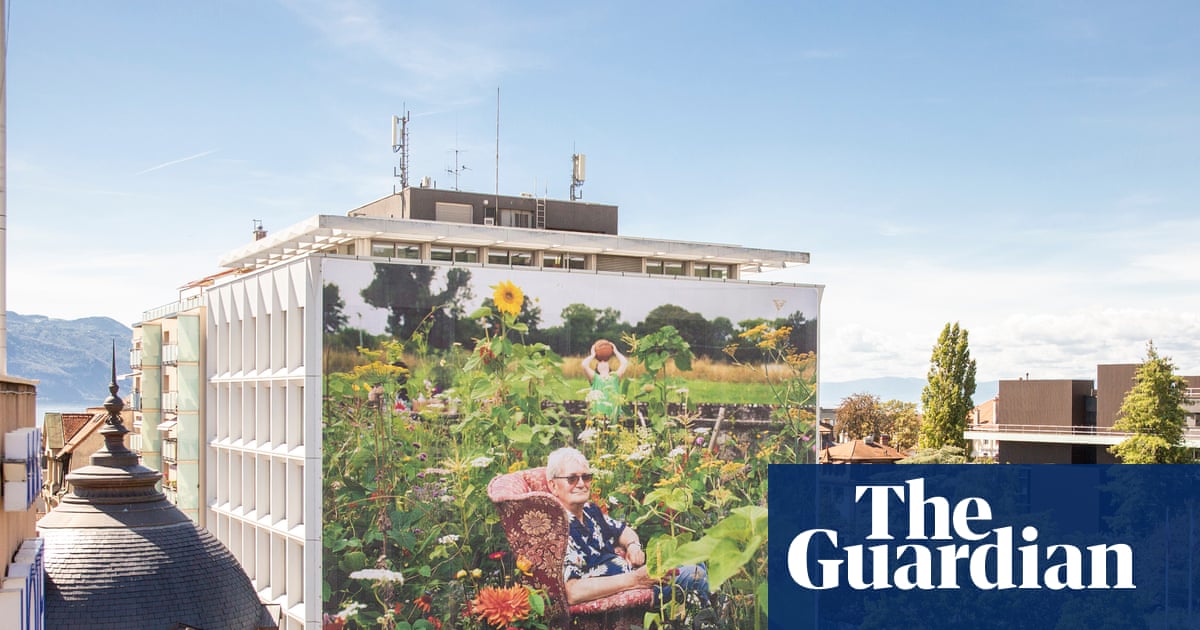
Every two years, on the shores of Lake Geneva at the foot of the Swiss Alps, the town of Vevey transforms its public spaces and buildings with 50 installations of artistic projects from 21 countries, which are free and open to the public. With such a breathtaking natural setting as its backdrop, the photography displayed at Images Vevey has to strike its own particular note of magnificence to hold the gaze.
Rising six storeys high, Sian Davey’s portrait of the renowned photographer Martin Parr, who died at the end of last year, sets the tone for this year’s festival. Taken in a splendid garden that seems to have flourished straight from Eden, the monumental portrait overlooks the town.
Martin was a significant and much-loved member of the Images Vevey family, having exhibited his own work here on a number of occasions. It is fitting then, that he should embody this year’s theme, “We Are Family”.
When Martin arrived to visit Sian he had recently received a terminal cancer diagnosis but Sian recalls the serenity he experienced in the garden. That sense of peace radiates from the portrait as he watches over the town in a fitting tribute.
The creation of the garden itself was a labour of love for Sian and her son Luke. As you can see in the portrait of Martin and in the other photographs in the display, it’s also the playground of Sian’s daughter, Alice, making this in every sense a family affair.
Many of this year’s family-themed projects are a study of love and loss, connection and separation. In Barbara Davatz’s series As Time Goes By the starting point is the relationship between couples who visited her studio from 1982 onwards. Over the course of three decades, she charts their changing relationships creating a fascinating kind of family tree.
Uncomplicated by props or elaborate staging, her subjects are presented in their purest form, inviting us to contemplate the course of their lives and the shifting nature of family bonds over time.
One of the most joyful series on display is Martina Bacigalupo’s Showing How Big the Sky Is, a project that charts 10 years of personal correspondence and amusing snapshots exchanged via WhatsApp and Skype with her former nanny, Chiou Taur Wu, who she affectionately describes as “auntie”.
“I love being barefoot. Because when your feet are not tied you are free.” Chiou told Martina, offering a glimpse into the context of her life.
Born into poverty in Taiwan in 1948 and deprived of an education, Chiou left the country to marry an Italian sailor and began new life with him in Portfino. But her hopes for a brighter future were dashed when she discovered he had mounting gambling debts which she then spent decades paying off.
One of the jobs she took on was caring for Martina and her brother, Tomaso. In all she spent 32 years with the family until retiring back to Taiwan. There, at the age of 70 she resolved to live on her own terms. She returned to education, took dance classes and began an adventure travelling around Asia.
Now she is playing and sharing her enchantment with the world with Martina. These vibrant and witty photographs tell of the love and the lasting bond between the two.
When Karolina Wojtas was a little girl, she was perfectly content as an only child. The very idea of a sibling filled her with dark thoughts. “I’ll kill them and eat them,” she told her parents when the subject was raised. So when her little brother arrived when she was 13, turbulence was perhaps inevitable.
Her project bravely delves into the complex territory of sibling rivalry. The scenes she creates with her brother are infused with humour, tenderness, and at times, a touch of cruelty – decorating him with frankfurters or vegetables for example. Presented at the festival in an anarchic, staged playroom, the images confront us with the messy, funny and sometimes uncomfortable truth of growing up together.
The chains of generations of oppression and poverty link together the story of the Appalachian people explored by the photojournalist Stacy Kranitz, winner of the Images Vevey book award 2025/2026 for her photobook project Ain’t No Grave Gonna Hold My Body Down.
-
Family standing in front of cabin, near Mt. Sterling, North Carolina © Great Smoky Mountains National Park Archive
Drawing on archive photographs dating back more than a century, alongside newspaper reports charting the heroic early pioneers’ descent into poverty and isolation, the work examines the purpose of photography: is it to bear witness or a tool of propaganda?
Stacy tells the story of how these once proud and courageous people made their way to the mountain ranges of the eastern United States, only to be exploited by mining companies who left them economically impoverished and socially isolated.
During the 1960s, the American author and historian Harry M. Caudill further stigmatised the Appalachian people by arguing that their circumstances couldn’t be fixed. In film footage unearthed by Stacy, Caudill claims that genetic deficiencies had amplified their plight, a theory later echoed in JD Vance’s memoir Hillbilly Elegy, which traces his own family’s Appalachian roots.
Fast forward to the present and, in the photographs Stacy has made of Pat Greene and his friends and family, we see a cycle of deprivation that remains unbroken. Through this project, Stacy challenges stereotypes and assumptions that allow a single image to define people and their circumstances. She draws attention to a system stacked against those who need help most.
-
Pat with his daughter Vicky on her birthday. Untitled, possibly related to ‘The Blizzard family’, Kempton, West Virginia, 1939 © John Vachon, Farm Security Administration, Stacy Kranitz.
Fiona Shields attended Images Vevey at its invitation