


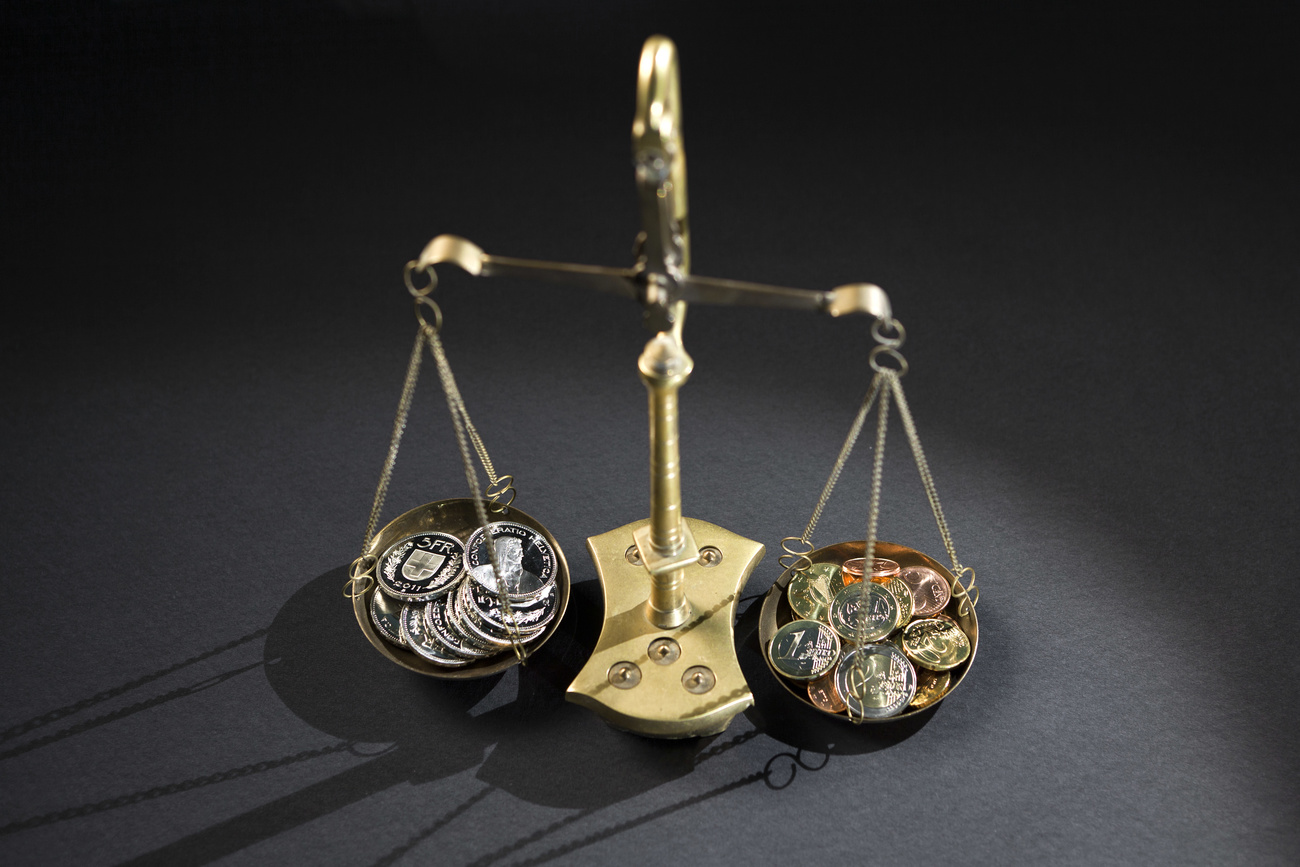
Interest rates affect mortgage debt and bank savings.
Keystone / Gaetan Bally
In many countries, central banks are raising interest rates. Does this put pressure on the Swiss National Bank (SNB) to follow suit?
Current key interest rates: Switzerland’s central bank has set a key interest rate of 0% – a rate that is uniquely low by global standards. It has been in place for over a year. This means that borrowing money is cheap, while money held in a bank account earns little or no interest. The next SNB interest rate decision is due on September 24.
An international comparison: Key interest rates in the United States range between 3.5% and 3.75%, whilst the rate set by the European Central Bank (ECB) stands at 2.25%. In all likelihood, the ECB will raise its rate at its next meeting (see forecasts below).
This is because interest rates are used to keep inflation low. Numerous European countries are experiencing rising inflation rates. The average stood at 2.9% in of July 2026. In the US, the current inflation rate is 3.4%.
Resilience: Low interest rates, low public debt, low inflation – in many respects, Switzerland is in a better financial position than other countries.
Caroline Hilb, head of investment and pension provision at Raiffeisen Bank, attributes the low interest rates to low inflation and the strong Swiss franc. “Switzerland has a very strong track record of debt discipline, of which it is also proud,” she said.
Switzerland also enforces a “debt brake” – a mechanism to ensure that government spending does not overshoot income over the passage of time.
More

More
Explainer: extraordinary Swiss spending meets the Debt Brake
In boom times, the government must use surplus revenues to pay off debt. This allows for an overspend during fallow economic years and balance the books through economic cycles
“This helps to limit debt and prevent the state from spending taxpayers’ money recklessly,” said UBS bank chief economist, Daniel Kalt.
Mortgages: These have risen slightly in Switzerland. According to price comparison website Comparis, ten-year mortgages currently average 1.9%. “Interest rates are part of an international landscape. Even Switzerland cannot escape this. When interest rates rise in the US, this also pushes up Swiss interest rates,” said Hilb.
At the same time, she emphasises that this rise has been “significantly weaker” than in other European countries or in the US.
More

More
Mortgages in Switzerland: how the system works
The outlook for Switzerland: Kalt believes that Switzerland is not under pressure to raise interest rates. “Inflation is still too low for that,” he said.
The rate of inflation in Switzerland stood at 0.8% in August. “At present, inflationary pressure is still too low and the Swiss franc is too stable for there to be any need to adjust interest rates,” said Hilb.
EU and US forecasts: The two economists also agree that the ECB will probably raise interest rates on September 10. However, they differ in their views on the US. Kalt also expects a US interest rate rise.
But for Hilb: “The Federal Reserve’s statements have been too vague.” No interest rate move is expected, “partly because it has never happened historically in the run-up to the mid-term elections”.
More
More
The positives and negatives of Swiss interest rates
Translated from German, sub-edited by Matthew Allen/ac