

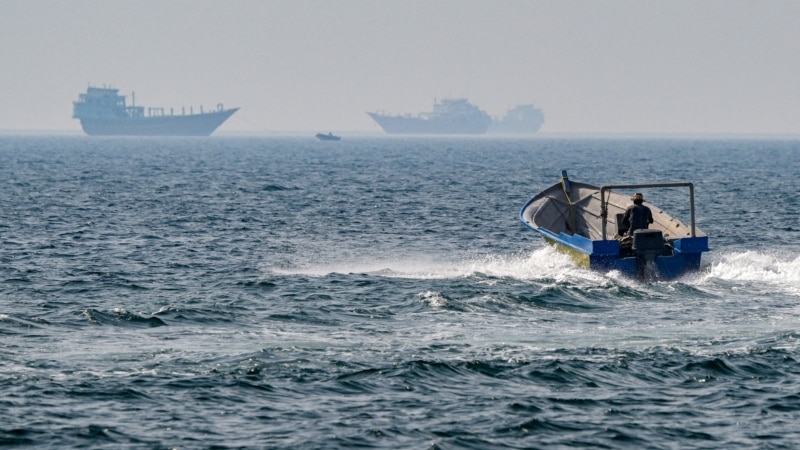
Iran said it has opened the Strait of Hormuz to commercial shipping traffic for the remainder of a 10-day cease-fire between Israel and Lebanon, and US President Donald Trump again suggested that Washington and Tehran could reach a deal to end the US-Israeli war with Iran in the near future.
The Strait of Hormuz, which leads to the Persian Gulf and was the conduit for 20 percent of global oil and liquefied natural gas shipments before the war began on February 28, will be “completely open” for the duration of the Israel-Lebanon truce, Iranian Foreign Minister Abbas Araqchi said in a social media post on April 17.
The strait, which leads into and out of the Persian Gulf, had been effectively closed to traffic amid Tehran’s strikes at targets around the Middle East, sending oil prices skyrocketing and shaking the global economy. Oil prices dropped and stock prices rose on world markets following the announcement.
The US-brokered 10-day cease-fire Israel-Lebanon took effect on April 16 and can be extended by mutual agreement. Iran has repeatedly said that an end to Israeli attacks on Lebanon, where Israel has been targeting Iran-backed Hezbollah sites since March 2, was a requirement for its own peace negotiations with the United States.
A militant group and political party that controls much of southern Lebanon, Hezbollah is considered a terrorist organization by the United States, while the European Union has blacklisted its only armed wing. A two-week cease-fire agreed by Iran and the United States on April 7 does not include Lebanon.
Shortly after Araqchi’s post about the strait, Trump posted a message of gratitude on his Truth Social platform.
“IRAN HAS JUST ANNOUNCED THAT THE STRAIT OF IRAN IS FULLY OPEN AND READY FOR FULL PASSAGE,” he wrote in a reference to Hormuz. “THANK YOU!”
“Iran has agreed to never close the Strait of Hormuz again. It will no longer be used as a weapon against the World!” Trump wrote in a subsequent post.
In yet another Truth Social message, Trump said a US blockade on Iranian ports would “remain in full force…until such time as our transaction with Iran is 100% complete.” The United States imposed the blockade, aimed at preventing ships from entering or leaving Iranian ports, on April 13.
Trump said he expects a resolution of the conflict with Iran will come “very quickly,” asserting that “most of the points are already negotiated.”
It was the latest in a string of upbeat comments from Trump on the prospects for a deal to end the war, which is halted by the cease-fire that expires on April 22.
“We’re going to see what happens. But I think we’re very close to making a deal with Iran,” Trump said on April 16, repeating the word “close” several times and adding, “There’s a very good chance we’re going to make a deal.” Later the same day, he told a crowd that the war was going “swimmingly” and that it “should be ending pretty soon.”